The Viridian Voice

hamadryad

– a review of Papillon Perfumery Dryad

Once upon a time some long time ago, in a house on a hill, lived a little girl with her parents. Daddy left every morning for work, Mommy had other preoccupations, and the house was so isolated, she had no neighboring children to play with. What she did have was the wood that surrounded the house on either side, and the imagination to fill it, with characters she heard about through the stories her mother read to her. In the beginning, Teddy the Bear stood in for handsome princes from fairy tales, and Raggedy Ann for all the princesses in peril, and sometimes, she would recreate a favorite story of another little girl, who lived alone in a faraway land with a monkey called Herr Nilsson, and was strong enough to lift her own horse.

But soon, she discovered other characters – the animals who lived there. The birds chatting in the trees, the squirrels who would eye her in the autumn as they came down from the trees to search for acorns and hickory nuts before deciding she was no threat to them, searching onward for their winter stash. The crafty raccoons who stole leaf-wrapped peanut butter sandwiches when she wasn’t looking and sometimes ventured close enough to talk and make her laugh at their antics. The foxes that eyed her from a safe distance and carried on dancing with their cubs, barking when they ventured too far for safety.

Towering above them all the green canopy of trees; hickory, maple and birch, wild pear, cottonwood, fir, larch and oak. She would watch the sunlight through the leaves in spring as it found the forest floor, the motes of pollen whirling towards the sun, and notice how the greens shifted through the seasons; from the spring green of her favorite crayons, to the richer, darker greens of high summer and the inky greens of the fir trees, through to the crimsons, oranges and golds of autumn, when the wild pears offered up their fruit, with the tough, bitter skins hiding a juicy-sweet treat, and next, the trees stood bare and unadorned, sleeping like the black bears she would also sometimes see. But as time went on and the little girl grew, she chatted less and listened more.

For the trees were talking, to each other and sometimes, to her, in slow, sonorous rumbles and whispers on hot, sleepy summer afternoons, and in excited, proud rustles showing off their spring finery, in melancholy, sleepy sighs on blustery, rainy autumn days, and in the occasional creak and shift of roots as winter went its way.

They were alive, this she knew, knew it in her very bones, alive precisely as much as she herself, and because she welcomed them in with no reservations, they in their turn guarded her, as she brought flowers she picked and laid by their roots, and sang for them songs she knew to sing.

The wood was her joy and her refuge when Mommy told her ‘no’, when Daddy was away too long, when the world outside the wood was less than kind to imaginative little girls.

That little girl was me some very long time ago, in a small wood across the ocean and far away, from a time I thought I had forgotten.

Except I never did. To this day, the forest – these days, it’s the beeches that surround my town – always, but alwaysgives me joy. Today, we even have scientific proof of what that little girl always knew – trees do indeed communicate in highly sophisticated ways, if only we people would learn to listen.

In that winding, whirling way of memory and emotion, in ways not even I can entirely articulate, Papillon Perfumery’s Dryad took me back in an instant to that early childhood memory, to the happiness I always felt there, and to those unforgettable trees.

Whether through the strength of those memories, or simple inclination, I am a Green Fiend. These nearly nine years of perfume writing have expanded my tastes to an increasingly catholic degree, but somewhere near the bedrock of my soul, a green burns with an emerald fury, and will never, ever fade.

When Dryad was released in 2017, I sat up and took notice. I cursed the UK postal restrictions that initially meant I couldn’t try it, and cursed my impecunious circumstances that ruled out buying a sample from elsewhere. There was somethingabout Dryad, I knew it in my bones, something I needed, something I had been seeking forever and never entirely found.

Well, I thought, singing along with Mick Jagger. I couldn’t always get what I wanted, but I got what I needed.

Until that fateful day a wonderfully kind, generous Perfume Fairy, or else one of my patronesses Freyja or Danu whispered in her ear, decided I needed to try Dryad. It came about in a perfume group thread, and lo and behold, on my otherwise not-at-all-spectacular birthday (exit the Dude, who won’t be back), an envelope arrived, (also) containing a generous decant of Dryad.

In an instant, I was all of four again, listening to the songs of the trees.

The next day, I sampled it in earnest, sat down in a swoon on my chair, and cried, cried like I hadn’t since a tiny sample of vintage Vent Vert extrait also took me far away for other, far more grown-up reasons.

Vent Vert is all sharply delineated Parisian chic and chartreuse hope emerging after long, dark years.

Dryad is very different.

Galbanum – a resin used as incense and perfume for thousands of years – is a very difficult material to work it in perfume. It can turn bitchy and evil and monstrously green. It can be a top note, a base note or a through-and-through note. But it takes a breathtaking amount of skill to make it, as indeed it is here, numinous.

I could take you through the notes as they unfold, tell you of that effervescent, citrus-herbal opening song, tell you of its softly floral heart and an unexpected and delightful apricot kiss, I could tell you tales of jonquil, that soft, voluptuous sister of narcissus, tell you how its sweetly mossy drydown some many hours later lands you on a forest floor where nettles never sting, where ants never march and vetiver never growls. I could write of all of that, and it would not be, would never be enough. Galbanum is the heartbeat and the pulse of this perfume, and it is the end and the beginning of Dryad. Rendered as exquisitely as it is here, it is nearly my undoing.

For all my love of green perfumes, I know nothing in the slightest like Dryad. I own not a few; my beloved Chêne, Vent Vert, Bandit, Antonia, Chanel no. 19, Ivoire, vintage Lauren, the staggering vintage Jacomo Silences. Ever-greens all, and ever-loved.

They are not Dryad, are not so atavistic, nor so primal, never so wild nor so bewitching, so free or untamed.

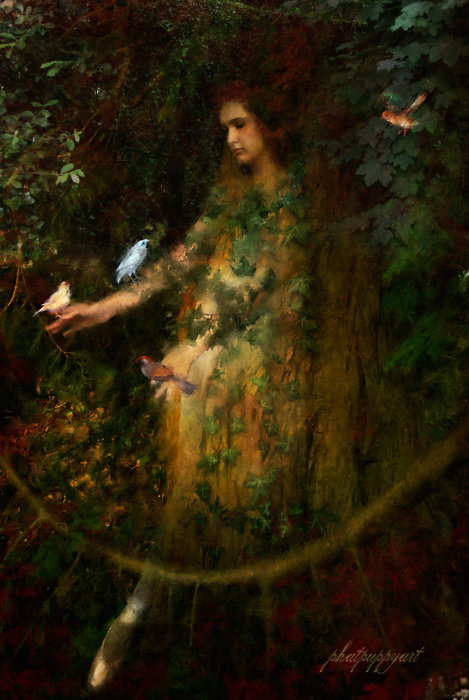
It’s as if Liz Moores set out to capture – as indeed she did in both the name and the juice – the hamadryad, the guardian spirit of a particular tree, but not just any tree, nor just any passing dryad. This is a witchy, bottled Balanos, the spirit of an oak tree, and in that spirit are echoes of other trees in other times. In Dryad’s floral heart, she left a little of her own soul, and to my own surprise and ever-lasting wonder, I rediscovered not a little of my own.

Or as a favorite, ancient poet once wrote:

When the beech prospers

Through spells and litanies

The oak tops entangle

There is hope for the tree.

(from the Câdd Goddeu)

A viridian voice that sings: wearing this, there is even hope for me.

With thanks and profoundest gratitude to the super-generous Tora, who made these words possible. And to the ever-wondrous Liz Moores of Papillon, whose magick conjured them out.

Notes: Bergamot, galbanum, bitter orange, cedrat, clary sage, thyme, tarragon, jonquil, orange blossom, lavender, orris, costus, apricot, oakmoss, vetiver, benzoin, Peru balsam, styrax.

Papillon Perfumery Dryad is available as an eau de parfum (with 16+ hour longevity, no less, at least on me) at Luckyscent, First in Fragrance and Les Senteurs.

The PushmipullyOud

bluepushmipullya

– a review of Amouage The Library Collection Opus XI

I don’t know about you, dear reader, but my mind is a strange place. I imagine all sorts of scenarios about perfume materials, not because I don’t like them, but because I wonder. A scenario like this one, for instance:

One day in the Neolithic era in a remote rainforest in tropical Asia, a tribe decided they needed a new canoe. So they managed to fell an aquilaria tree of just the right height, girth and shape, only to discover that the heartwood of the tree was diseased, attacked by a mould we know today as Phialphora parasitica. No matter. They scraped it out bit by bit, and threw chips of heartwood on the fire. Lo and behold, a fragrance unlike any other in the world rose with the smoke to the sky above.

Lo and behold, that otherworldly, haunting stuff we know today as agarwood, or more commonly in perfumery by its Arabic name oud was discovered.

Natural oud is not only one of the rarest and most costly of perfumery materials on the planet, it is also one of the most temperamental. There is no such thing as a consistent ‘oud’ odor profile.

Oud can be floral, fruity, intensely animalic, medicinal or indolic. (To put it mildly.) The quality varies from tree to tree, which takes the whole terroir discussion to a whole new level of complexity, depending on location, growing conditions, weather or type of aquilaria tree.

We have Indian oud, Malaysian oud, Thai, Burmese, Vietnamese, Laotian and Cambodian oud. They smell nothing alike in the slightest in a way even my oversized vocabulary struggles to describe.

It is so prohibitively expensive that it is also one of the most adulterated perfumery substances of all. Not so many years ago, we in the West wised up to what the peoples of the Middle East had known for thousands of years, and so oud – more ‘oud-a-like’ or synthetic than natural – became the material du jour, with every niche perfumery jumping on the trend bandwagon to release oud perfume A, B and Z in their hundreds. Due to the ever-increasing demand, aquilaria trees – and mainly, aquilaria malaccensisare now among the most endangered species of wood on Earth, and the price keeps moving in one direction: to the ionosphere, if not all the way out to the Kuiper Belt.

Efforts have been made to create aquilaria plantations, but the infections are not consistent, and the results are still somewhat inconclusive as to whether or not this will mean natural oud will be saved from extinction.

I for one won’t hold my breath. Of all that can and does go into the perfumes I love and adore, oud is without question the note I struggle with the most. Most pure ouds turn me an unfashionable shade of green as I head screaming for the hills to scrub and scrub and scrub, but I hasten to add that my experience has been rather limited.

Handled carefully, oud is a majestic Thing of Beauty. When I think of oud, I think of my own favorites containing oud: Aftelier’s breathtaking Oud Luban, my gateway oud, Neela Vermeire Créations Trayee with its numinous oud note, or Amouage Epic Woman, which especially in frosty weather takes many winding twists and turns towards the stupendous drydown to land on yet another supernatural oud, or the stellar discontinued Yves Saint Laurent M7, to name but four off the top of my head.

But generally speaking, I can’t stand the stuff.

Yes, I’m the Big Bad Oud Philistine. Feel free to throw eggs and tomatoes. No, I probably haven’t met the ‘right’ oud yet.

If I want barnyard, I know just where to go – a stable not too far from here with all the horse droppings and horses any horse-mad girl could ask for, never mind my own schoolgirl olfactory memories of mucking out the stables of the horses I took care of twice a day.

Animalic? Readers, I adore castoreum, labdanum and musk notes in perfumery. I also curated a spectacular perfume project that utilized all of those. Sexy does it.

I’ll be getting back to that one.

Which brings me to the latest from Amouage’s Library Collection, Opus XI.

Unlike the previous volumes VIII-X of the Library Collection, Opus XI slants emphatically masculine. Maybe I should have written that with a capital M, because quite frankly, my chest is far too lumpy and nowhere hirsute enough for Opus XI.

What I’ve long suspected about the Library Collection has since been confirmed by far better perfume writers than I – that in the creation of its volumes, Creative Director Christopher Chong gets to metaphorically let his hair down a little and play/experiment with perfumery ideas.

If the main and side collections of Amouage are the seven-movement polyphonic symphonies and four-act operas of the perfume world, the Library Collection perfumes are the sonatas and etudes, every single one of them made without sacrificing a nanometer of the ‘drop-dead haute couture-grade hand-woven, petits mains-embroidered silk brocade’ brand aesthetic of Amouage, which to my mind is no small accomplishment.

Even  – or perhaps especially – Opus XI.

Opus XI was created in collaboration with perfumer Pierre Negrin, and before I incriminate myself further, it’s really and utterly all about the oud, if nothing like what most perfumistas and all oud lovers associate with that word.

It contains what could be the shortest note list of any Amouage to date (which says something); marjoram, that polite, well-mannered cousin of oregano, oud both natural and synthetic, a Firmenich compound known as leatherwood which so far as I’m aware combines the best of both notes, and a sly, smoky styrax.

All told, it sounds rather simple. Yet Opus XI is one of the strangest and most confounding perfumes I’ve smelled to date, for reasons I’ll explain.

As stated before, I have Major Oud Issues. I’m the Big Bad Oud Philistine. You may as well just kill me now and be done with it.

For the first few seconds – and it’s only a few seconds – I get a violet vibe, as in the flower and the color. And then. And then, the oud comes roaring out of the gate. Not a barnyard, indolic oud, nor a floral, a fruity or even an animalic oud, but the scent of what could be the most exclusive, expensive band-aids money can possibly buy.

Billionaire band-aids.

In this case, it’s schizophrenic billionaire band-aids. Opus XI  is medicinal bordering on clinical, but the biggest surprise is the extraordinary tension between a silky-smooth natural oud and a synthetic, sharper, edgier oud where neither gives an inch to the other. Marjoram gilds these two with greener, fluffier outlines as time passes, but these two ouds are, to misquote Oscar Wilde, dueling to the death, and neither  will go. Not in the first five minutes, not in the first five hours, nor even in the first ten.

This is an Amouage. It stays the course.

Around the eleventh hour (see what I did there?), the billionaire band-aids sigh, if such a thing were possible, and shift, and leatherwood and that sly, smoky styrax slither in, adding a glossy sheen and lots of cohesion to those ouds that finally expire some time around the eighteen-hour mark.

If that sounds strange to you, it gets even stranger. Not so long ago when the Dude was still around, I rolled out my mastery of rhetoric to persuade him to try it on his (masculine, hirsute) skin. Mr. Ardent Fougère Lover was not easily persuaded. Had this been Bracken Man, I would have had to hide the bottle. But after about an hour of my most diabolical demonstration of logos, ethos and pathos to date, he finally caved in.

Willingly or not, his skin brought in that justly celebrated sexy oud. Make that Sexy Oud.  Somehow, some way, there was no tension and no duel to the death, just one of the smoothest, sexiest perfumes his skin had ever encountered, as indeed it has encountered quite a few.

Luckily, he had to leave, or he might not have survived. And just to set the record straight, he did not like it. At. All.

This Bactrian camel, on the other hand, could have walked several miles in hot, lascivious pursuit for a chance to sniff that Sexy Oud again.

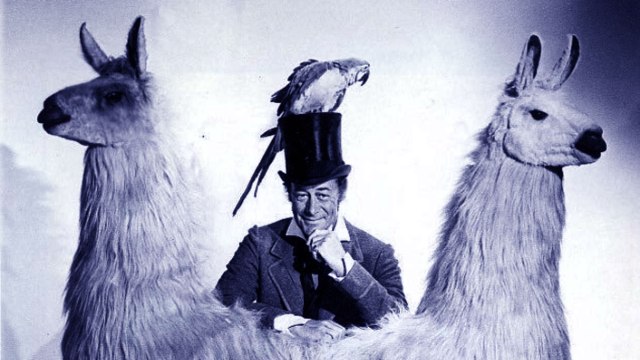
Opus XI is, as I’ve written above, one of the most confounding perfumes I’ve sniffed this year. Like the exceedingly rare creature the pushmipullyou of Dr. Doolittle fame, it’s hard to determine if it even can move.

Which is why I call it the PushmipullyOud. A most exceedingly rare creature indeed.

Notes: Marjoram, oud, leatherwood, styrax.

Amouage The Library Collection Opus XI is available as a 50 ml eau de parfum directly from the Amouage website.

Disclosure: A sample was provided for review by Amouage. This post was not sponsored, and my opinions are my own. With thanks to the Very August Personage.

Should your curiosity about oud be killing you, Ensar Oud comes highly recommended by some of the best noses I know.

The Color of Wonder

gadisarjaisalmersunrise

– a review of Neela Vermeire Créations Rahele

In a day and age when mass transportation has made travel to anywhere on Earth not just possible, but attainable, imagination has to fill in the spaces for when travel meant not just adventure and opportunity, but also danger. Most people never left the villages and towns where they were born and raised.

Ships could sink in a storm, caravans could be robbed by thieves, and at every turn, hostile natives or malevolent bugs large and small could lay waiting for the unwary.

Yet human curiosity burned bright and hot enough to send the intrepid Magellan and Sir Francis Drake around the world, caravans traversed the Silk Road from west to east and back again, and everywhere ‘elsewhere’ great discoveries awaited; revolutionary ideas, marvelous merchandise, peoples, faiths and histories without number.

The lucky ones who returned with tales of faraway, fabled places set the European imagination alight with their stories of unimaginable splendor, unfathomable wealth, and ancient, sophisticated civilizations vastly different than their own.

Three fearless Frenchmen, Jean Baptiste Tavernier, a jeweler and merchant, François Bernier, a physician and Jean de Thévenot, a linguist and botanist, all of who lived to return to France and tell their tales, set off at the behest of first Cardinal Richelieu and later Louis XIV himself, to find themselves in that fabled land that fanned the tallest flames and tales of all: India.

Like all true travelers everywhere, their own lives would be forever changed, and they themselves would change others’ lives as well, not least through their published stories of their travels, which were translated into several languages and lit up the imaginations of generations of armchair-traveling Europeans to come. At different times in their lives, the paths of all three men crossed. De Thévenot and Tavernier hoped to travel overland together from Isfahan in Persia to India, and Bernier and Tavernier met in India.

Jean Baptiste Tavernier was the Harry Winston of his day, buying and selling gems as well as Persian and Indian textiles. He became especially famous for bringing home the ‘French Blue’ diamond, a centerpiece of the French crown jewels, before it disappeared in 1791, only to reappear recut in 1830 as the diamond we know today as the Hope diamond.

François Bernier went to India to become first the court physician to Dara Shikoh, the eldest son of Shah Jahan who built the Taj Mahal, and later, to Dara Shikoh’s younger brother and successor Aurangzeb and the Mughal court. In an age where there were very few reliable travelogues to the Orient, his Travels In the Mughal Empire, based in part on accounts of officials at the Mughal court as well as his own first-hand observations, became a European sensation. Bernier also became the first – and for a long time, the only – European to travel to Kashmir.

Jean De Thévenot, an independently wealthy scholar and linguist fluent in Turkish, Arabic and Persian, also published his own travelogues, as well as making considerable contributions to botany through his travels, observations and botanical collections through India in 1667-8.

These three gentlemen and the stories they wrote of their travels became the inspiration for Neela Vermeire’s 2016 release Rahele, the Persian word for ‘traveler’, yet Rahele has a twist in its tale. Here, you’ll find no associations of ‘East-meets-West’ so much as ‘West-meets-East’, with an open mind and an absolutely marvelous sense of wonder.

Often, our associations of the Mughal Empire are somewhat, well, tainted by Victorian-era letters and books, written from that lethally close-minded Victorian (and imperialist) viewpoint, which sadly makes us forget that in Tavernier, Bernier and de Thévenots day in the 17thcentury, attitudes towards other cultures and perhaps Mughal India in particular were very different and far more open. Believe it or not, this expansiveness is very much reflected in Rahele the perfume.

As always, Rahele was created in that flawless pas-de-deux of Neela Vermeire with the perfumer Bertrand Duchaufour. Six peerless perfumes later, it becomes very clear that Neela Vermeire knows precisely how to push the justly celebrated M. Duchaufour’s work higher and farther than it has ever been before. She has never compromised on her creative visions of what she wants her perfumes to embody, always held out for the best and most elevated concept of her exquisitely articulate ideas, and Duchaufour has shown an uncanny and profound understanding of precisely what it takes to get both of them there in essence and absolute.

Rahele – the Traveler – speaks to the adventurer in all of us, even those of us who can’t travel beyond our armchairs. We are all of us on the road to somewhere, but Rahele reminds me of a description of the Tarot trump The Chariot – travel in luxurious circumstances. And such a journey lies ahead …

From its beginnings, Rahele is a chypre born and bred, that most uniquely perfume-y of all perfume families, and in my chypre-biased opinion the most difficult to execute. Rahele opens big, spicy and jungle green, with its unmistakeable Duchaufour cardamom and a grassy violet leaf and green mandarin kick that tells you you’re definitely not anything near the Paris of the seventeenth century.

This is a wonder of a very different order, everywhere apparent in Rahele’s floral heart. Osmanthus takes center stage, but this is not your usual osmanthus of apricot and leather, this is an altogether grander bloom. This is an osmanthus veiled, kholed and bejeweled with its intimations of rose, violet, jasmine and a lemon velvet magnolia to tame osmanthus’ fruity sweetness and make it stay the course.

Some long time later, well before osmanthus has overstayed its welcome, a deep, silken cloud of cedar and sandalwood – if not Mysore, which it could be, then some alchemical sleight of hand that achieves the precise same effect, with glove leather and sotto voce whispers of patchouli and oakmoss.

I’m reminded of a pivotal moment in another context, when I realized that the inlaid flowers of the Taj Mahal are made of precious stones set in white marble, and the world was never quite the same again. Rahele has that same effect; its flowers embroidered in liquid to bloom forevermore.

The overall effect is the perfume equivalent of the embroidered muslin pantaloons worn by the ladies of the Mughal court; sophisticated, beautiful, as opulent as silk brocade yet  as transparent as gauze.

Like all Vermeires, it lasts a surprisingly long time – I get at least 8+ hours, but Rahele’s sillage wears close to the skin after the first hour or so, and will not overwhelm either your own nose or your surroundings.

I found myself dreaming often about those three Frenchman wearing Rahele. Thinking of what it must have been like to experience that jaw-dropping awe in the face of the Mughal reality, when suddenly, the world – or rather, their understanding of what ‘the world’ encompassed – grew and grew like some revelatory Rajasthani sunrise, broader and far richer in all senses of the word than anything they ever knew in the Sun King’s realm.

Call Rahele  the color of wonder. And call yourself lucky to exist in a world where such marvels may still be discovered.

Notes: Green mandarin, cardamom, cinnamon, violet leaf, osmanthus, rose, magnolia, jasmine, iris, violet, cedar, sandalwood, oakmoss, patchouli, leather

Disclosure: A sample was kindly provided for review by Neela Vermeire. For which I thank her from the bottom of my heart. My opinions are my own, and no posts on the Alembicated Genie are ever sponsored.

Neela Vermeire Créations Rahele is available as an eau de parfum at LuckyscentFirst in Fragrance and directly from Neela Vermeire Crèations.

Three Odes to Osmanthus

2_zpsbij8mgjg

three osmanthus-based perfumes for Spring

This morning, as I trudged to one of the few open grocery stores for milk for my coffee, something very obvious hit me on the way.

It is (still) a glorious, calm, bright blue, perfect Spring day. The sun is blazing away, there’s a hint of actual warmth in the air, and after being blasted by a wicked Easter nor’easter for over a week that kept the garret nearly arctic, the contrast is intoxicating. Somewhere in that shriveled black, cynical heart I call my own, all that daylight through my opened windows is wreaking havoc with wintery pessimism and however-shall-I-survive-exam-season-with-my-integrity-intact speculations. I might actually survive exam season, after all. (Especially if I read up!)

There might even … dare I write it … be possibilities for a perfume writer of dubious repute?

Because it’s Spring! And what better way to celebrate Spring than by wearing a flower that blooms in August and September? Anyone?

The flower is osmanthus fragrans, or as it’s known in English, sweet tea olive. Osmanthus the flower (last sniffed at the CPH Botanical Gardens in September) is a whole, opulent perfume in itself. It somehow manages to exude floralcy, fruity-apricots-with-a-tinge-of-marzipan and animalic leather/suede all at once.

So once I returned this morning, I hauled out three odes to osmanthus. They all contain differing interpretations of this humble little flower with the big odor profile I so adore, and few florals exemplify Spring quite so nicely.

The fruity flower

Parfum d’Empire Osmanthus Interdite (2007)

Perfumer: Marc-Antoine Corticchiato

A very long time ago, I blind-bought 10 ml of an Osmanthus Interdite split on the theory that a) I loved osmanthus and b) Marc-Antoine Corticciato has never, to my knowledge, made a bad perfume.

I’m not familiar with all of Parfum d’Empire’s perfumes, but of the ones I have tried, they are rather spectacular and highly unusual. I could write volumes on Azemours Les Orangers‘ orange grove perfection (and wail that my decant is practically empty), but Osmanthus Interdite  – another fast-diminishing decant – did not prove me wrong with either a) or b).

Inspired by the Forbidden City of Beijing, Osmanthus Interdite puts the flower front and center with an epic green tea note – a sibling of that other green tea note I once loved allthe way to discontinuation in Bvlgari’s ground-breaking Eau du Thé Verte. It begins with airy, lemony osmanthus, who introduces herself and slyly retreats as the green tea steps forward. Half an hour later, she makes another, grander entrance, bolstered by a hint of rose and jasmine, and now, we can sense her for what she truly is: a stunning, fruity floral for sophisticated grownups, blowing juicy apricot kisses to the adoring crowds, bridging the gap between smell and taste, which is smaller than you think.

The rose and jasmine hold her in place for the duration (6+ hours on me), and accentuates a hint of the soap she also conceals in her orange-yellow depths, before she finally drifts off on an exquisitely tanned suede accord to gild her edges.

I say ‘her’, since osmanthus in general strikes me as very much a feminine note, and Osmanthus Interdite  – ‘forbidden Osmanthus’ is very feminine to my nose. But don’t let that stop you – this would be fantastic on a man with the fortitude to thumb his nose at perfume conventions. Feminine, yes, but not frilly and with no perfume-y flou in sight, just a beautifully rendered osmanthus perfume that is always – again, a hallmark of Parfum d’Empire – always sophisticated, flawlessly delineated, and perfectly rendered.

Notes for Osmanthus Interdite:

Osmanthus, green tea, apricot, jasmine, rose, musk, suede

The Sultry Blooms

Perris Monte CarloAbsolue d’Osmanthe(2016)

Perris Monte Carlo came to my attention about two years ago when a perfume writer friend of mine reviewed their Ylang Ylang Nosy Be so beautifully, I wanted to forfeit a rent check and just buy it already. So I ordered a few samples from First in Fragrance, but for whatever reason, my order for a sample of Ylang Ylang Nosy Be didn’t go through, nor did my comment requesting it on my order. Absolue d’Osmanthe, however, arrived instead. If it’s any indication of the quality of the rest of the line as I suspect, then I’m done for.

Creative Director Gian Luca Perris took a very different tack with this osmanthus. This osmanthus is sourced from Guinan in China, famous for the quality of its osmanthus absolute.

Quality is the operative word here. Absolue d’Osmanthe exists in two incarnations – as do the other members of the Perris Monte Carlo Black Line – as an eau de parfum, and as a hyper-luxe extrait. Although I only have a sample of the eau de parfum, you’ll hear no complaints. As it is, Absolue d’Osmanthe has heft and sultriness to spare.

Sultry, I hear you ask? Sultry! Is my emphatic reply, for M. Perris avoided all the obvious traps of airy-fairy, girly osmanthus and decided to accentuate the, ahem, sexier side of osmanthus, by pairing it with the animale hidden within sandalwood, tolu balsam, vanilla (a dry and very woody vanilla without sweetness) and tied it all up with a pretty jasmine sambac bow. Voilà! Sultry osmanthus. I would never have guessed that sandalwood and osmanthus could sing such a duet, but sing, they do. The osmanthus is apparent right from the start, apricot and marzipan tones all accounted for, but the sandalwood makes the heart beat faster – in both the wearer and the perfume, before the tolu, labdanum and vanilla sashay in on orange-tinted sunbeams to show you just what osmanthus can also do. It is easily unisex and would be spectacular on the right guy. It lasted a full day through all its many twists and turns, and that, too was a surprise. Now, I have to hunt down samples of the rest of the Perris Monte Carlo Black Line (to start). Damn it.

Notes for Perris Monte Carlo Absolue d’Osmanthe: Osmanthus, jasmine sambac, sandalwood, vanilla, tolu balsam, labdanum.

The Silken Suede

Parfums Serge Lutens Daim Blond(2004)

Perfumer: Christopher Sheldrake

My gateway osmanthus is remarkable for not listing any osmanthus at all, but a not-at-all abstract representation of its listed notes that somehow, some way, all add up to an elegantly restrained, decidedly chic flower I shall henceforth refer to as ‘osmanthus-with-extras’.

Daim Blond came under my nose by way of a sample courtesy of the superlative perfume writer Lucy of Indieperfume, and it was – and eight years on, still is – love at first and four-hundred-and-fortieth sniff. I’ve worn it a lot this past winter when I needed to be reminded of alternatives to blustery, frigid days, or simply something besides my January disillusioned self.

It gets stranger still. One of my most loathed perfume notes in nature – the smell of flowering hawthorn, which induces instant, all-encompassing nausea – is listed as a top note, and although I can detect faint traces of hawthorn, I don’t care nearly enough to make a fuss about it, since the rest of it is simply glorious.

Apparently, Daim Blond is quite divisive, if the reviews on Basenotes and Fragrantica are anything to go by. Some smell a derivative Feminité du Bois, some a reworking of the great Iris Silver Mist, some a truckload of ‘tamed’ Arabie (a criminal thought!), and some just complain that M. Lutens was simply repeating himself and his famous Orientalist aesthetic. YMMV.

Yet I named Daim Blond my gateway osmanthus, because it was the first osmanthus-tinged perfume I encountered that I actually loved, enough to remember it when a friend asked about a birthday present and I suggested Daim Blond off the top of my head. Since it arrived, it has remained in constant rotation for the past three years, appropriate whether April or August or January, whether a school day of linguistics for ADHD students, or a night out in Copenhagen.

Like most masterpieces of perfumery and a few humans too, it exists between the spaces of its contradictions. Just as the odor profile of osmanthus itself, it is simultaneously fruity, floral and suede-leathery all at once, and this suede has the texture of melted Isigny butter. Wherever that suede came from, I’ll wager that was one exceedingly pampered goat/pig/cow.

But I would be hard pressed to name notes as such, for no other reason than on my skin, I get osmanthus in all its orange-gold glory, a smidge of a very discreet musk, and that flawlessly prepared suede. That’s all, and that’s already more than I deserve.

Notes for Daim Blond: Hawthorn, cardamom, iris, apricot stone, (iris?) pallida, musk, heliotrope, leather.

The osmanthus may bloom in August in Guinan, but few flowers put quite so much Spring in my steps as osmanthus. If you like yours bold with a side of opulence, I recommend Amouage Journey Woman. There is another fragrant traveler in my test drawer, but that one gets its own review. Stay tuned!

A Violet Tsunami

insolencepurple

– A review of Guerlain Insolence eau de parfum

On my way to purgatory/school every morning, the train passes through a series of beechwoods that line a deep river valley – the ‘deepest’ (we’re not talking a gorge here) in Denmark. And every morning, I keep my eyes peeled for the sheltered, south-facing spots beneath the trees and under the bracken, a telltale patch of tiny, round, emerald leaves. From what I’ve seen, it won’t be long before one of my personal favorite things about Spring arrives – the tiny, unassuming and deeply fragrant wood violet.

Pity the poor violet. Already, I’ve written unassuming. One hundred and twenty years ago, violet was arguably one of the most popular soliflores, adored by dandies and debutantes, grandes dames and ingénues alike, for its innocence, its lack of assumption, its sweet, green floralcy, and if not the violet, then its leaves, exuding grass and haricot vert, both flower and leaf containing the promise and the deliverance of spring.

I’ve loved violet for a long, long time, ever since a wax sample of Bois de Violette landed on my desk and for all its autumnal woody swags and flourishes, it brought me back in an instant to the beechwood floor and a tiny, purple-white bloom.

Violets and roses share common notes, and in combination give us the impression of expensive lipstick. Later, the heartbreaking violet note in another Lutens/Sheldrake creation, De Profundis, came along to blow my proboscis to smithereens, and yet another passionate violet-tinged love affair began, before I was gifted with a vintage mini of one of the greatest and grandest of them all, Germaine Cellier’s Jolie Madame for Balmain, which not only brought back indelible childhood memories of my mother’s perfume and the fur coat it saturated, but just about did the adult perfume writer mein, for being so perfectly rounded, delineated and composed.

You may have Guerlain’s Après l’Ondée at the top of your purple passions (I haven’t spent nearly enough time with it), but for me, Jolie Madame is at the very top of my own as one of the three Last Words On Violet(s).

It may be that to your mind, violets skew feminine or girly. Not so. Oriza L. Legrands Violettes de Czar is a very elegant, nostalgic and highly refined masculine, broad-shouldered violet that all but twirls its metaphorical Edwardian moustache, and if modern violet is your jam, I recommend Mona di Orio’s staggering Violette Fumée, an easily unisex, surprising twist on everything we thought we knew and not a few things we didn’t – about violets.

We have Italian violets in Borsari’s Violetta di Parma, and the sugary, sweeter violets of Toulouse in Berdues’ violet perfumes.

To the extent they have any common denominator, it’s that these violets – all of them justifiably famous violets – tread lightly on the ground. These are not insistent violets so much as insistently – and consistently – great violets, each with their own qualities, profiles and personalities.

Then came Insolence. If it came with an epithet, I could call it the Beast (of a) Violet.

Insolence, created in 2006 in a collaboration with the great Maurice Roucel and Sylvaine Delacourte at Guerlain, began life as an eau de toilette, and went on to encompass seven different flankers, one of which is the bottle now sitting on my desk in its dark purple bottle – the eau de parfum.

The eau de toilette – despite all our wailing that Guerlains no longer have any longevity (debatable) whatsoever – was a raspberry-violet-orange blossom bombshell with jaw-dropping sillage, created like most Guerlains these days for the ‘modern young woman’, but no ‘modern young woman’ – I personally know fifteen below twenty-five who fit the bill – would ever dare to be quite so … audacious in these perfume-phobic times. They’re all about blending in, whereas I am far past caring, and by Golly, if I want to be audacious, then audacious it is, and let them think what they may.

That attitude may be why I finally pulled the trigger at an online discounter last fall and bought a bottle of the eau de parfum in the ‘dirty dishes’ Serge Mansau bottle, and to hell with all consequences.

The first surprise was Ms Hare, who heard herself saying: “But this is good!” Later that same day, when I confronted the Dude with it, the second surprise was his reaction: “That smells delightful!”

Delightful? Seriously? Have I become so accustomed to perfumery avant-garde that I’m shocked when my immediate surroundings actually like my perfume?

Well … yes. Because it took me – a perfume writer these eight years and counting – not a little time before Icame around to Insolence. It was a bit like your first trip to the beach after an endless winter. You know the water will be cold, so you take in the ocean one toe at a time before diving in. For a long time, I took in Insolence one teeny spray at a time for fear my neighbor, the check-out girl, my study group, my teachers, the canteen ladies and my entire class of teachers-to-be would complain.

Loudly.

An inappropriate TL; DR way to describe Insolence compared to the rest of the Guerlains would be this:

Imagine Après l’Ondée has had her heart broken –again. One fatal night, she downs an entire bottle of 180-proof methyl ionone in her despair, and calls up her BF Tonka Imperiale, who drops everything and comes running over, all friendly concern, TLC and one forlorn, secret hope. And that was a whole bottle of 180-proof methyl ionone. Nine months later, Insolence arrives as a souvenir.

Accurate or not, this is not how perfume writers are made.

Insolence starts her life with a fog horn of an opening. I do mean – fog horn. Violet – this one is emphatically not shy, not unassuming, not, in short, anything like any violet tropes you might think you know, but loud AND proud – is hitting up the town with her friends raspberry and orange blossom, and this night of all nights, they’re all more than a little … tipsy. By the time iris and tonka bean arrive to chaperone them home, violet is still dancing on the tables to hoots and acclamation singing Piaf as she does into the table lamp, raspberry and orange blossom have long disappeared with two highly disreputable gentlemen, and everyone wakes up with a hangover the next day.

The iris adds deep, powdery facets, but we’re nowhere near baby powder territory here, this is a hard-to-obtain-even-in-Parisian-pharmacies face powder, which makes me suspect a smidge or two of damask rose deep within those purple depths. Some long, long time later, that violet is still in party mode, dancing her pas-de-deux with tonka bean, somehow becoming more true to her sweet, woody origins.

If Insolence contains any Guerlainade, I’d be hard-pressed to detect it, but being a Guerlain, crème patisserie always underpins the whole. It’s sweet, but not quite cloying, not quite over the top, not quite entirely… vulgar. It walks a line between extreme sophistication (I’ll get back to that) and outright brash vulgarity, but lucky for us, never dives all the way in.

Which brings me to my other main peeve.

Whoever among the marketing department of Guerlain came up with ‘modern young woman’ (because screw les femmes d’un certain age) should be shot on sight – or sniff. Just as I’d never recommend L’Heure Bleue to an ingénue, I hesitate to recommend Insolence to anyone below the age of twenty-five. It takes a kind of audacity to wear only achievable by age, and a degree of sophistication obtainable only by experience to appreciate. So I’ll go with ‘modern woman’, and ingénues need not apply. One way and another, I came around to Insolence, for all I wanted to loathe it. It’s precisely that tightrope between sophisticated and vulgar I so admire – and precisely why I think it’s brilliant. That too, is not something I’ve had to say about any newish Guerlain in a very long time.

A word of caution. If the eau de toilette was a bombshell, the eau de parfum is a violet H-BOMB. Meaning a little goes a l-o-n-g, long and LONG way. Three sprays have been known to last a full 16+ hours, something I’ve only experienced with certain extraits, most Tauers and all Amouages. The violet remains from topnotes to base notes, and that’s another first. Don’t wear this to a fancy dinner, darlings. Or if you do, apply lightly. Bring a decant. You can always apply more before hitting up that club, where you’re known by another name.

The Violet Tsunami. Take care it doesn’t sweep you, too, far, far away.

Notes for Insolence eau de parfum (from Fragrantica):Red berries, violet, iris, African orange flower, sandalwood, tonka bean, woody notes.

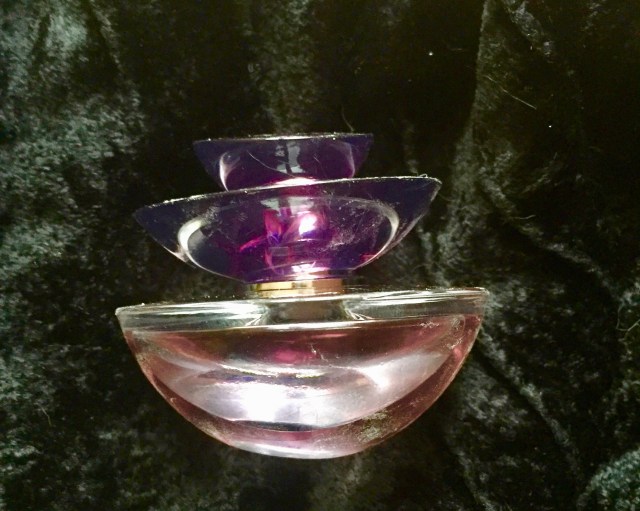
Insolence was originally created by Maurice Roucel and Sylvaine Delacourte for Guerlain in 2008. Available at perfume discounters, but be aware of the bottle – all previous Guerlain eaux de parfums in bottles of separate design are since 2017 sold in the “bee” bottles. I own the purple “stacked dirty dishes” edition shown below. Comments on Fragantica claim Insolence has since been reformulated and is now weaker and less tenacious.

IMG_5048