The Might of a Rose


–  a tale and a review of Neela Vermeire Créations Mohur Extrait
mohur2

Lahore, India – November 1627

So it had come to this. All her plans, her hopes and her dreams had come to nothing, reduced to ashes by her own brother’s betrayal. Shahryar had lost everything.

The power, the glory and might of the Mughal and all that was India would now pass to Shah Jahan, who had hated her from the moment sixteen years ago she wed Jahangir, who loathed the way she always favored his far more sensible brother Shahryar.

She had gambled everything on Shahryar, and so she too had lost all the power and influence she had acquired these past sixteen tumultuous years. Even her beloved was no more. Then again, perhaps she had lost him long ago to the lures of wine and opium.

Nur Jahan wrapped her shawl around her in the slight chill of this November evening, looked up from the missive in her hand and gazed unseeing at the intricate winding vines and flowers inlaid in the walls of her quarters.

“Majesty…” Akbar, her faithful retainer for several years, interrupted her reverie. “Asaf Khan has proposed that you retire to a palace here in Lahore with your rank and your privileges intact.”

“Has he now?” Nur Jahan had to laugh. “All my privileges, except the one that matters most, which he knows all too well.” She shrugged and knew with the ease of one who had reigned India in deed if not in name for many years that she would never show just how much her brother’s betrayal burned, never show her sorrow for fear Shah Jahan would have yet another weapon to use against her. One he would never hesitate to use.

“And yet, Majesty, would it be so terrible to have the time to dedicate to your interests? Your poetry, your music, your gardens and your perfumes? All without the distractions of rule, of court intrigue and the endless lines of petitioners at the jharoka receptions? You would no longer rule, it is true, but…” Not even Akbar was audacious enough to finish his own thought.

“There are many kinds of power and might, Akbar,” she snapped. At this late hour of the night, her voice showed the slightest hint of strain, as if everything transpired – the Emperor’s capture and death, Shah Jahan’s blatant refusal to obey her command at Kabul and this war of Jahangir’s succession – had somehow caught up with her.

“The power of poetry, the strength we gain from the music we love, the might of a perfect rose…”
NVCROSE

There was a thought. Nur Jahan stared again at the letter and saw not the black curves, dots and lines upon lines of doom and defeat, but instead the green leaves and dawn-pink petals of a fragrant rose, diamond droplets of dew glistening in the morning light in its silken folds. Such a rose as Jahangir had given her at Nowruz, the New Year so long ago, when she was no Nur Jahan but merely a widow and a disgraced diwan’s daughter named Mehr-un-Nissa.

What would it be, she wondered, to prove just what power a rose such as that could conceal, to leave as her epitaph not the just the Empress but the very woman she had been?

Very well, she thought. Let Shah Jahan have the Empire. Let him take it and rule it and ruin it with his extravagant ways and vaunting ambition.

She, once Empress of all India, would find her solace and her sustenance in her poetry, in her gardens and her charities, and in the perfumes she so loved, to dedicate her days and nights to the pursuit of a beauty so flawless, it could be none other than her own.

And so it came to be in the years that followed her exile from rule that she strove to capture all her myriad selves in her roses and in the perfumes those roses made, to somehow wrap up her essence as the epitaph she would choose to leave behind. It should contain the sharp, spicy scent of cardamom and coriander and pepper, to recall the laughing, lighthearted girl she once was so long ago in faraway Kandahar, perhaps with the jasmines she remembered blooming in the courtyard, and hints of the almond sweetmeats and pastries Jahangir once so loved to feed her. A dusting, like the powdered sugar on loukhoum, of the violets presented to her by those comical English in their outlandish garb, and a cool, purple touch of the elegant iris root from that remote land called Florence its ambassador had presented her with. It should contain the sharp tang of leather as well in happy memory of tiger hunts in the hillsides and the iron might she once wielded in a silken, fragrant glove, and the sacred, haunting trails of sandalwood, patchouli and oud that defined India as perhaps few other essences did. A sweet, luscious finish, as much as if to say that the Mehr-Un-Nissa she once was and the Nur Jahan she became were after all, one woman first, last and foremost.

All of these, the flowers and the herbs, the spices and sacred woods intricately embroidered onto the heart of a singular flower to prove the power of a woman such as Nur Jahan, and the might of her rose.

On a December day of chill and fog, when the Empress who once was Nur Jahan breathed her last, Akbar, an old man himself by this time, took her secret note and anointed it with that mighty rose perfume before he set it alight with a taper to release her story and her essence upon the wind for another to find and to remember… a woman once known to all as… the Light of the World.
7-Playing-Sitar-in-the-Shalimar-Gardens_-Lahore_-Pakistan_-1981

The Shalimar Gardens, Lahore, June 1947

On this sunny day, Edwina Mountbatten wasn’t sure what broke her heart the most, that she would soon say farewell to this wonder that was India, or that she had been fortunate enough to at least experience it and attempt to grasp and encompass all it was and now soon would become. Soon, these marvelous gardens would not even be Indian, but belong to a nation to be called Pakistan.

“It seems,” she said to her friend Jahawarlal Nehru as they walked, “such a pity and yet, such a necessity, that this will be another nation born of India’s ashes.”

“There is no other way, Edwina, as you well know.”

The sunlight danced in the fountains and the mannered geometry and the blaze of flowers should surely soothe any melancholy hearts and make any spirit soar to stroll amid such beauty on a day like today, when the roses bloomed their promise of a new era and a new future.

He sensed her pensive mood as they walked, as he so often did, and bent forward to pluck a perfect rose he presented to her with a flourish and a smile.

“Did you know,” he began, “there is a story about this variety of rose?”

Edwina laughed. “I do so love your stories. You have so many!”

“One of my many pleasures,” he murmured. “Ah, but this story… is a story of the fabled Nur Jahan.”

“She was quite a woman, I gather.”

“Indeed so, and quite extraordinarily talented, so I’ve been told. They say that when Asaf Khan ‘retired’ her, she dedicated her life to poetry, to charity and to perfumes.”

“Perfumes! Only in India…” Edwina buried her nose in the rose. It was like no other rose –certainly, no English rose – she had ever known, lush, deep, both majestic and piercing in its scent.

“You forget, in India, perfume is definition, devotion and adornment all in one. Something for you to think about, perhaps? Or at least consider…” he went on with another smile as they strolled onward, a precious stolen hour of serenity amid the separation talks. “And so the story goes about a perfume Nur Jahan made, and such a perfume they say it was. They say it was all her essence and all of the world, not merely India, wrapped around the might of a rose.”

“The might of a rose. I must say that phrase has a certain… power to it.”

“Well, she was am Empress, after all.”

“But of course.” Edwina breathed in her rose. It made her own British roses seem so indistinct and pallid in comparison. “But what about it? Did someone ever find the formula? I do like the idea of such a perfume.”

Nehru watched the diamond droplets of water flash above the fountain in the sunlight and refract in the air above the pool. As he thought, as Edwina walked beside him with this extraordinary rose in her hand, she thought with a pang that she might never see this fabled garden and its beauty again.

“How does it go, this tale of Nur Jahan’s mythical perfume… Ah! Well then, they say that when she died, her retainer burned the formula and released it into the wind for another to find in time. Remember, this was not simply a perfume, not just a scent to wear, but the very quintessence of an Empress of India. So it would be powerful and immensely rich, as she surely was, it would contain all her majesty and all her secrets. Not something you’d buy in Paris, perhaps. Power and majesty are not to be trifled with.”

“Something of which I suspect Her Majesty was well aware.”

Edwina tried to open up her heart, her soul, her very pores to drink it all in… the gardens, the sunlight, the company of her extraordinary friend and this extraordinary story of a perfume that sparked a longing in her heart to know it, to wear it, to breathe it, to be remembered by its presence.

“Certainly! Nur Jahan ruled an empire, let’s not forget. With an iron hand, I might add.”

“I don’t think I’ve ever encountered such a perfume that would say all those things to the world.”

“Ah, my friend, neither have I, and I am Indian, after all.”

“But that is such an extraordinary story! Power and majesty all contained in a vial of scent.”

“Sometimes,” Nehru’s thrilling voice trailed off as he looked into the distance, “it is better to take the sword than to surrender, fail or run away.”

“And should that sword be a rose?” Again, Edwina inhaled deeply from the rose in her hand. To her, it seemed as if this were so much more than a simple flower and so infinitely much more than a mere ‘rose’.

They walked on a while in the comfortable silence of friends. And then, Nehru looked at Edwina and at the rose in her hand.

“Remember…and this is something I can well imagine Nur Jahan saying herself…

‘Never underestimate the might of a rose.’
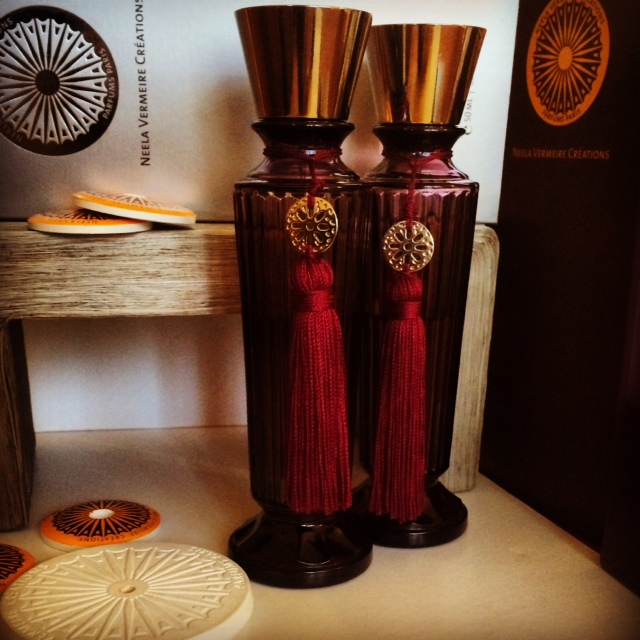
photo 3

____________________GIVEAWAY!___________________

Neela has offered to give away one ceramic perfume disk (for scenting drawers & closets) and a 10 ml decant of Mohur Extrait to one lucky reader in either the EU or the US, and a sample of Mohur Extrait to the two runners-up who comment on this post by midnight CET on Wednesday, May 21st. Mohur Extrait is a must-try even for those who don’t like rose – this is NOT your usual rose! Make sure to like Neela Vermeire Créations on Facebook and follow her on Twitter.  The winners of the giveaway will be drawn by random.org and announced here on TAG on Thursday, May 22nd. THIS GIVEAWAY IS NOW CLOSED.

__________________________________________________

Notes: Cardamom, coriander, ambrette seeds, carrot seeds, pepper, elemi, iris, jasmine, rose, violet, almond, leather, sandalwood, amber, patchouli, oud, benzoin, vanilla and tonka bean.

Neela Vermeire Créations Mohur Extrait is currently only available as a limited edition directly from the NVC website for customers in the EU. For US customers, contact Neela Vermeire Creations at info@neelavermeire.com.

Mohur Extrait was created by Neela Vermeire in collaboration with perfumer Bertrand Duchaufour.

Disclosure: A sample of Mohur Extrait was provided by Neela Vermeire. The story and review are my own, but the historical context, people and events mentioned are as accurate as research allowed.

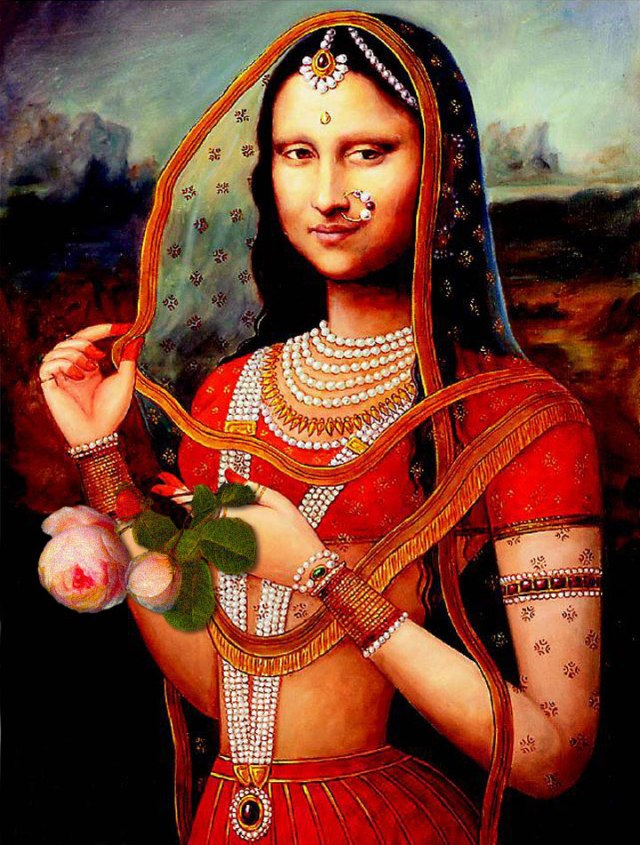
Painting: “Bani Thani”, by Rajasthani artist Gopal Khetanchi, with the addition of a 17th-century rose by yours truly.

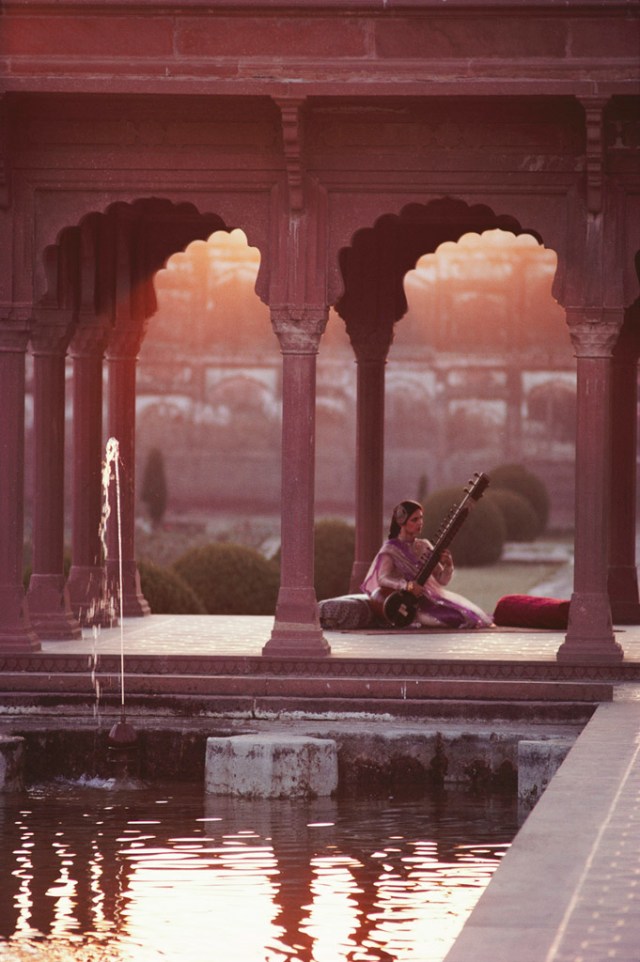
Photo from the Shalimar Gardens, Lahore by Roland & Sabrina Michaud.

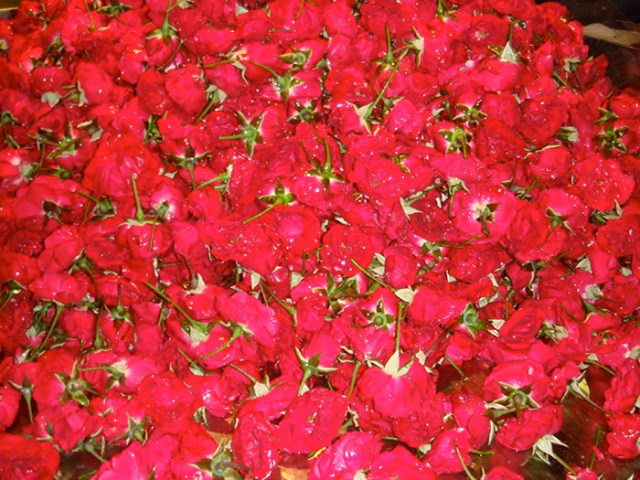
Rose petal photo from the flower market of Bangalore and presentation of Mohur Extrait bottle by Neela Vermeire. Used by permission.
 

A Past & Perfect Future

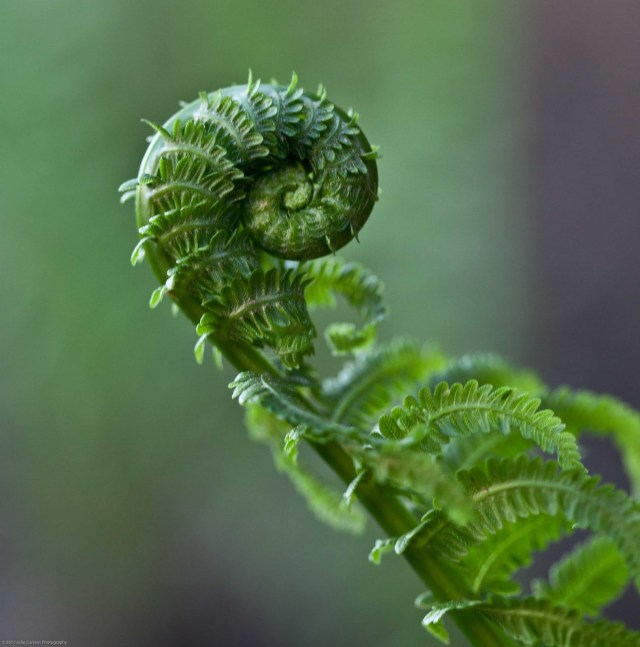
110518_fiddlehead_1

a review of DSH Perfumes ‘Passport à Paris’

I want you to imagine a right-angled triangle. At either end of the hypotenuse, you’ll find two revolutionary perfumes, and at the other end, a painting no less revolutionary than the perfumes. All three combine to tell one singular story, each contributing its part and its facets to the space described within those three points of reference, a story I shall attempt to tell…

Next, I’d like you to imagine a point in time over a hundred years ago when the future seemed so bright the world was blinded by its promise.

What would it have been like to be raised with a philosophy of a static, fixed life, and instead as you lived be constantly confronted with a present that offered the only given of the time and indeed any time – that of perpetual change? When you have been taught to see the world in representational terms; a perfume is a single flower of violet, lilac or rose (if you were respectable) or jasmine or tuberose (if you weren’t!)?

Just as a painting is a recognizable, carefully rendered image of a familiar reality, until a group of louche bohemian painters decide to rebel against artistic convention and orthodoxy and instead paint the shimmering air between themselves and their subject matter, and as they did, the world was taught to see itself anew, to see those careless smears of oil paint as representing people, places, captured fleeting moments in time and mood.

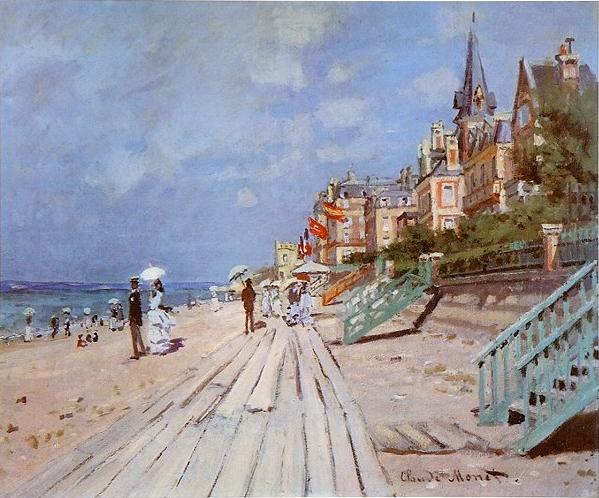
Claude Monet's 1870 painting, The beach at Trouville.

Claude Monet’s 1870 painting, The beach at Trouville.

In that restless, roiling age, another revolution waited in the wings, one perhaps anticipated by Guy de Maupassant when he wrote:

Ah! If we had other senses which would work other miracles for us, how many more things would we not discover?

It has happened on many occasions that I’ve wondered what it would be like to go back in time and be a metaphorical fly on the wall at, say, the Galeries Lafayette in Paris in the year 1882, when Paul Parquet of Houbigant presented his own heretical fragrant revolution to the world and decided to call it Fougère Royale.

Before that moment, perfumes were composed of natural essences and absolutes aspiring to be literal representations of the flowers that named them. Parquet gave an unsuspecting world something entirely new – an abstract and evolving perfume containing a synthetic aromachemical, coumarin (supposedly in a staggering 10% concentration), and with no known frame of reference at all, but instead, as Guy de Maupassant put it, ‘a prodigious evocation of forests, of lands, not via their flora but via their greenery.’

The world was never quite the same again, neither in art nor in the art of perfume, certainly not when Aimé Guerlain glanced sideways at Parquet’s creation seven years later and gave an unsuspecting world another olfactory revolution named Jicky.

Which brings me to the apparently limitless talents of Dawn Spencer Hurwitz and her third creation for the Passport To Paris exhibition at the Denver Art Museum called simply ‘Passport à Paris’. And as so often before with Dawn’s work, this one has special and highly personal meaning for me.

Her three points of inspiration – Claude Monet’s 1870 painting, The Beach at Trouville, Parquet’s original 1882 Fougère Royale for Houbigant and Aimé Guerlain’s Parquet-inspired Jicky – all somehow fed into Passport à Paris to provide not just a lesson in the zeitgeist of the time, but also to redefine it to a modern audience that has perhaps forgotten that once not so long ago, there really was no such thing as a fragrant story in a bottle.

I’ve never known Houbigant’s original Fougère Royale, and unless I make it to the Osmothèque at Versailles (trust me, it’s on the bucket list!), I never shall. But it so happens I had an opportunity to sniff the 2010 recreation by Rodrigo Flores-Roux at Pitti Fragranze last year, and it blew me away. Maybe it doesn’t have the original’s freshness and verve, and perhaps it’s a plusher, lusher interpretation of Parquet’s seminal idea, but it is all of a piece and entirely a glorious fougère, and I couldn’t wait to sniff it again – and to own it some day.

Jicky, on the other hand, is another story. Because on a beautiful day in early May in Paris a long, long time ago, Jicky was the very first perfume the 14-year-old tomboy I then was chose for myself. Like all teenage daughters throughout all time, I defined myself in my mother’s despite. If she chose Mitsouko and Shalimar, then I would instead choose something she would never wear, something for me alone and the me I hoped to become; unconventional, audacious, herbal-green and with more than a few hints of the sensuality I hoped to find in my nebulous future. At the time, I also knew that my literary idol Gabrielle Sidonie Colette wore Jicky, and if it were good enough for Colette, who was I to argue?

I wore Jicky throughout my teens and well into my twenties until I learned to define myself in other ways through other perfumes, but then again, you never do forget your first love. Not if you were Aimé Guerlain in a past life, nor even a young woman with a secret aspiration to set the world alight with her words.

So you can well imagine that immediate rush of emotion, recognition and revelation when I sprayed Passport à Paris for the first time.

I nearly fell off my chair.

In an instant, I was brought back to those two moments – a surreptitious sniff and two sprays at the crowded Stazione Leopolda in Florence, and another far more pivotal point in time upstairs at the Guerlain boutique on that distant May afternoon on a sofa, when a smiling sales assistant, well used to gawky teenagers and their stylish mothers, proffered a storied perfume and I found a kind of self-definition in a bottle I could never have even hoped to imagine.

Passport à Paris is all of that, all of history and heritage and heresy, and yet… it is also, just like its inspirations, entirely itself and entirely new. Fougère Royale can never be what it once was and Jicky today is a wan, thin ghost of its former voluptuously curvy, decadent self.

Tant pis. I can honestly say I no longer care so long as beauty such as this exists.

I could walk you through its evolution, from the citrus song of its opening to its herbal, emerald-green, floral-tinged heart and on to a far drydown many hours later that hints of amber glints in the firelight embracing patchouli, ambergris and civet. I could tell you all of these are both apparent and discernible and yet… not. For here it’s not the olfactory words or notes themselves that matter so much as it is the overall feel and mood they emanate.

If ever a perfume somehow managed to convey the sinuous twists and turns of Art Nouveau, evoking an age of aesthetes and voluptuaries and a perpetual revolution and evolution of ideas, of art, of the art of perfume… it would be this one. That it manages, like all of Dawn’s historically inspired perfumes to appear both timeless and brand-new is a marvel.

I’ve read that some people have complained that DSH perfumes are ephemeral, transparent, discreet and fleeting. Not Passport à Paris. I have slept with it, woken up with it, worn it and adored it over twelve hours after applying it.

As a perfume writer, it happens I encounter a perfume so good, I catch myself thinking that if I don’t own it, I shall die of heartbreak and despair. More often than not, that fit of acquisition passes.

Not this time and not this one. Passport à Paris will be the very first perfume I buy next.

Because in attempting to breathe the past to life, Dawn Spencer Hurwitz somehow managed to evoke a perfect future unfurling like the fern above and a past that imagined the future as perfect.

If I don’t own such beauty, I shall die of heartbreak and despair.

Passport à Paris is available as an eau de parfum and as parfum directly from the DSH perfumes’ site.

Notes: Lemon, bergamot, lavender, palisander rosewood, mandarin orange, jasmine, Bulgarian rose, orris, clover, Australian sandalwood, amber, vanilla, coumarin, ambergris, Indian patchouli and civet.

Disclosure: A sample of Passport à Paris was provided by Dawn Spencer Hurwitz for review. I’m not worthy.

Also a huge and grateful thank you to the very dear friend who sent me a sample of vintage Jicky parfum.

Refractions in a Jasmine’s Eye

mcescher1

–  a review of Amouage Opus VIII

In over three and a half years of perfume blogging, I’ve reviewed over five hundred perfumes. Some great, some spectacular and some… not quite so much. Some reviews have come easy and some have come hard, not because I hated the perfume (although that has happened), but because in order for me to haul out The Perfume Reviewer kicking and screaming (because she basically just wants to enjoy it), I have to find an angle, a hook, bait to reel the reader in.

In all that time and with all those marvels, nothing I ever review – and I’d like to emphasize this – is ever so hard to hook, angle or locate the bait as just about any Amouage.

Once upon a storied time – how can it be three years ago? – I dismissed Amouage as being too rich for my blood, just another hyped-up hyper-luxurious brand that couldn’t possibly live up to the accolades heaped upon it. I can’t afford even one of them. I’d cover my ears and sing “La-la-la, I can’t hear you!” when my fellow friends and perfume bloggers sang its praises on their blogs. Finally, I gave in to my own relentless curiosity and those verbal, knowing smirks from those same friends and bloggers and ordered two outrageously expensive Amouage samples of Epic Woman and Ubar at First in Fragrance just to knock them down to an approachable, human size.

The rest, as they say, is history. Whether I’ve surprised myself writing narratives or merely bathetic attempts to just capture my impressions in words, by all the patron saints of perfume they are, every last one I’ve tried, really… all that and so much more.

It pains me more than you know to bang my head against the keyboard and tell you their newest release, the Library Collection’s Opus VIII, is no exception to that rule. It also proves just as slippery and elusive to decline and define.

I’ve long had the sneaking suspicion that the unisex Library Collection is where Creative Director Christopher Chong lets his inspirations run a little looser and freer and gives his perfumers license to write literature in essence, absolute and accords. If Opus V could be called Carnal Iris, and Opus VI Odysseys in Amber, Opus VII was a bottled Edgar Allan Poe tale all the best and sublimely Gothic ways titled Spenser’s Forest.

Opus VIII is a new tale in a new setting with countless plot twists and turns, this one as blinding sunshine bright as Opus VII was moody, magnificent darkness.

I don’t know how or even why, since it’s listed nowhere in the notes or anywhere else I could find, but on me, Opus VIII begins as incendiary green as a morning in early May. Jasmine sambac is indeed a greener, fruitier variety of jasmine, which might explain why I was kicked awake and aware by an emerald green punch of fizzy, razor-sharp Persian lime.

Lime! Not mojito, not caipirinha and not at all margarita, but a warm, bittersweet green sunrise as a heliotropic jasmine begins to unfurl and that blinding bright gilds its edges and everything begins to glow, everywhere you sniff. Was that a hint of banana leaf? No. It’s that heady jasmine. Or else it’s the sensuous sparks of saffron and ginger firing up the floral fireworks.

But instead of your usual summer fireworks imagery, see instead a jasmine sambac chrysanthemum bomb exploding in an endless hall of mirrors, some convex, others concave, and yet others flat, wavy and in varying hues of blues, golds and greens. You just don’t know where to look, never mind how to sniff. The florals are distorted and painted large on scented woody billboards advertising alternative, gravity-defying magic carpet rides of what flowers are able to do in a perfume if they’re allowed.

Once thing is certain – they’ve never quite done this before.

Ylang ylang, with those custard and banana leaf undertones dances and flirts with the jasmine in perfect step with frankincense adding its own lemony, woody allure.

Like all the Opus line and indeed most Amouages, Opus VIII is incredibly hard to parse. Just when you think you have it all mapped out, the figurative magic carpet is pulled out from under you. Up is down and down is up. Jasmine is not at all jasmine sambac, but instead a phantasmagorical jasmine, no! Wait! Orange blossom! Yes?

No… it’s this spicy, woody superstructure elevating all the flowers up and up – or is that down?

Reflections? Refractions? I could apply both words equally well to convey my impressions. I’ve worn this on at least twelve occasions and worn twelve different perfumes – sometimes, it’s that jasmine sambac core that dominates and sometimes, it’s the woody superstructure that shares certain similarities with a few recent masculine releases, notably Fate Man.

What I will have to tell you is that this journey through a sunlit hall of mirrors takes hours and hours, and as you make your way through this jasmine sambac labyrinth, you’ll never know what you may find or even how to find it. This is possibly the most cohesive yet utterly discombobulating perfume I’ve ever sniffed.

To say I’m confounded is understating the issue. I suspect that’s both the raison d’être and the modus operandi of Opus VIII. To offer up reflections of flowers – some real, some imagined – swirling around a jasmine sambac vortex suspended in a spicy, woody, deliciously bittersweet base that by both inspirations and perfumers’ sleight of hand all add up to endless and endlessly entertaining…

Refractions in a jasmine sambac’s eye.

The Library Collection’s Opus VIII will soon be available at Luckyscent, MiN New York, First in Fragrance and directly from the Amouage website.

Notes: Jasmine sambac, ylang ylang, orange blossom, frankincense, saffron, ginger, vetiver, gaiac wood, benzoin, Jamaican bay.

Perfumers: Pierre Negrin & Richard Herpin in collaboration with Creative Director Christopher Chong.

Disclosure: A sample of Opus VIII was provided for review by Amouage. For which I thank the Very August Personage.

Illustration: M.C. Escher.

Ooh La Laugh Fraise

pigstrawberries

a review of DSH Perfumes Amouse Bouche from the Passport to Paris Collection

In a winter that has dragged on for what seems like an eternity as one wet, super-extended November, life ground itself down to a dark gray powder as plaintive and as melancholy as any early Bergman film.

Melancholy is no state of mind with which to celebrate the coming arrival of spring. For spring, we need exuberance, beauty and above all things else, a perfume to put a smile on our faces, a cancan laugh on our skin and not a little sunshine in our souls.

Of all the perfume families I have become enamored with over the course of my life, few make me run for the hills faster than the dreaded fruity floral/oriental. In fact, the mere term ‘berry’ anything turns me green in all the worst ways. I am neither so young nor so naïve to think it necessary to waft any berry in my wake to add to my dubious allure.

Nothing pleases me more than to eat my words and give myself over with a rueful laugh to the wonders of my all-time favorite berry of all.

Strawberry.

Imagine it. A succulent, fragrant, red berry in front of you with all its promises of a carefree summer’s day dances its exuberant Galop Infernal around crème frangipane and a flaky, warm brioche. I double dare you not to feel your wintry cares drop to the flowering ground like so many superfluous woolen overcoats.

Dawn Spencer Hurwitz’ Amouse Bouche – part of her triptych of perfumes created for the Denver Art Museum’s Passport to Paris exhibition – is that kind of strawberry.

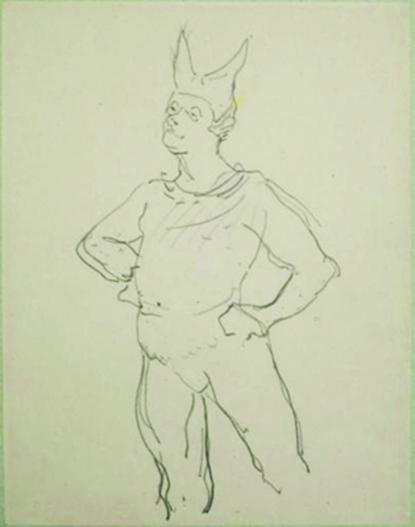
Amouse Bouche (the misspelling is an intentional visual pun) was inspired by the Paris of the Belle Époque and by a humorous sketch by Henri Toulouse-Lautrec called The Dunce’s Cap.

I dare you to look at that simple sketch without smiling.

I dare you to look at that simple sketch without smiling.

With such inspirations, it would figure that this is a) neither an ordinary strawberry nor b) an ordinary fruity-floral gourmand.

I don’t know what I expected, and you’d think I’d have a few ideas by now. Nevertheless, here it is. Yours truly, conquered by a laughing strawberry extravaganza as swirling and dizzying as any Art Nouveau curves, as lighthearted and flirtatious as the cancan dancers at the Moulin Rouge and with all of La Goulue’s unrivalled appetite for all of life’s most delectable pleasures.

Follow me now Messieurs et Madames, in through these ruby red doors into a sparkling, ever-present heart of luscious strawberry (with optional lemony champagne). Do you feel your cares melting away by the minute, can you sense how winter all but burns to an wisp of fog in your mind in that juicy, happy heart of light?

Come in, come in! Our show is only just beginning as all your winter-worn cares vanish like smoke in the limelight, for here come our belles of the ball in their strawberry skirts and their flashing black stockings, les dames fleuries, the blushing jasmine and the queenly rose, the neroli with her saucy winks and the ylang with her sunshine yellow laugh.

Cold? What cold? Impossible to be cold in such warm and happy company as the troupe dances out and in again as the crowd roars its approval, as the strawberries twirl in aldehyde champagne and dulcet buttery vanilla whirls its pas de deux with caramel until at long, long last, only the sandalwoody gloss of tonka bean and vetiver fade away as the sun rises over Montmartre.

When you know that in those hours in the magical dark only laughter and sunshine breathed, when all winter woes and worries fled far, far north. All that remained was the joyous memory of an ooh la laugh of strawberry bliss and even your soul was very amused indeed.

strawberrypiglet

Notes: Aldehydes, strawberry, bergamot, lemon, grandiflorum jasmine, Bulgarian rose, neroli, ylang ylang, butter CO2 extract, Tahitian vanilla, ambrette seed CO2 extract, caramel, tonka bean, Australian sandalwood, vetiver.

Amouse Bouche is available from the DSH Perfumes website, where sample sets of the entire Passport to Paris collection are also available and absolutely recommended.

Disclosure: A sample of Amouse Bouche was provided for review by Dawn Spencer Hurwitz. For which I thank her with my words, a wink and a laugh and a half! 

Personal Geography

geographiamundi

–  a review of Body Made Luminous by Scent By Alexis

If my evolution as a perfume writer these past three and a half years has taught me anything at all, it is to fervently believe in the Jungian concept of synchronicity, in other words, that everything that transpired since that slightly tipsy August night in 2010 has happened for a reason and with the precise epiphanies and people I needed. Or as a 19th-century lawyer once said in another context:

In nature there are neither rewards nor punishments; there are consequences.

One of those consequences of my perfume writing was being invited to participate in Lucy Raubertas’ Clarimonde Project, a perfume project of perfumers and bloggers created to celebrate and elaborate upon Thèophile Gautier’s haunting 1837 short story La Morte Amoureuse. The perfumes created for the Clarimonde Project were all so incredibly evocative I can honestly say that from that October onward, my life and my perspectives really did change in ways it took me a very long time to appreciate.

The Clarimonde Project was also my first ‘proper’ introduction to perfumer Alexis Karl of Scent By Alexis and co-founder with Maria McElroy (of aroma M) of the House of Cherry Bomb, who contributed with their perfume Immortal Mine.

Immortal Mine changed everything for me, brought me into the story and elaborated upon it in ways no other medium could, and literally blew my mind. I have never before and rarely since (with the exception of the scents created for my own Devilscent project) sniffed anything so dangerous in my life. Even today, even after over four hundred reviews, I still consider my story/review of Immortal Mine (a fictional continuation of Gautier’s story) among my finest and proudest moments in writing, and that stoppered vial of amber perfume oil with its red lacquer seal stands among my most cherished possessions.

Except the fun didn’t end there, for along the way and ever since, Alexis has become one of my dearest friends and closest inspirations, for we have countless preoccupations and interests in common. Like Alexis, I, too, had a cemetery for a playground as a young child. (True story!) And we both have the Gothic aesthetic – in the widest, most encompassing sense of the word – built into our very DNA.

Only one word can truly describe something of Alexis Karl  – musician, singer extraordinaire, art instructor, teacher, painter, sculptor and perfumer – and that is polyhistor.

When she chose to resurrect her perfume line, she was inspired by Michel Foucault’s essay Utopia of the Body, in which Foucault ponders how our physical bodies define and explicate us, and yet, there is that inevitable dichotomy of body and soul. But is it really a dichotomy? Or could it be, as Foucault himself says in the essay:

It will last a long time, my soul, more than “a long time”, when my body comes to rot. It is my body made luminous, purified, virtuous, agile, mobile, warm, fresh.

Body Made Luminous is a perfume made for that moment when body and soul come seamlessly together as an indivisible entity, when we are so infinitely more than our physical skin, the moment we are clarified and elucidated by a loved one’s gaze or touch and body and soul are knit together whole and entire from all our disparate, fragmented selves.

Having been lucky enough to have tried her collaborations with Maria McElroy, I’m thrilled to say that Alexis’ voluptuous aesthetic is everywhere in evidence right from the first spray. There’s a lot of base (and lots of bass) in her perfumes, so much so it feels pointless to discuss anything so banal as top-heart-base architecture, because this perfume – as indeed did Immortal Mine – operates on an entirely different scale.

This is very, very heady stuff.

Imagine… chocolate. Some artisanal, arcane and very hard to obtain single estate Criollo where the cocoa beans are cosseted and coaxed into their most kaleidoscopic expressions to end their glory days as the ultimate manifestation of some Celestial Law of Chocolate.

Any fellow chocolate lover will understand what I mean. This is the scent of that 80% chocolate lovingly tempered over the embers of fossilized Moroccan amber, before it is transformed by skill and dedication into some other occult revelation hidden in the Nahuatl word ‘xocolatl’.

Amber may be petrified tree resin, yet there is nothing in the slightest vegetal about this amber. This amber is the animal within, the animal all of us take such pains to conceal, the animal that perhaps more than any other defines and delineates Michel Foucault’s ‘utopia of the body’, the utopia within us that is nowhere because it is everywhere inside us, waiting for its moment to emerge and growl its reasons upon our skin or in the air between us and someone we love.

But that low, animal purr is tempered somewhat by a floral caress of … rose? Tuberose? A smidge of jasmine and orange blossom? I don’t know for certain – I don’t have the notes – and by this time in its evolution, neither do I care.

Body Made Luminous is a total seduction of all the senses, a gourmand for gluttons and voluptuaries, libertines, decadents and sworn sybarites, a symphony in chocolate and a lesson in mapping out our selves, our spaces and the uniquely personal geography that defines us all.

Body Made Luminous is available as an eau de parfum (with 14+ hour longevity on me!) from Indie Scents and from the aroma M/House of Cherry Bomb studio in Dumbo, NY, which is open between 1 & 6 PM on Mondays and Fridays at 68, Jay Street, Dumbo, # 1007.

Notes (via Indie Scents): Moroccan fossilized amber, chocolate and flowers.

Disclosure: A sample of Body Made Luminous was made available by Alexis Karl, for which I thank her from the bottom of my ink-black, Gothic, gluttonous heart.

For much more on Alexis Karl, I highly recommend Lucy’s portrait at Indieperfumes.

Find Scent By Alexis here.