In Pantherine Ink

junglepanther

 – a review of Serge Lutens’ Sarrasins

Once a creature of fable lived, old stories tell, and some say it was a very large, most fearsome cat, and some say it was an animal of another kind, but all of them agree it emanated a most singular and exceptional perfume, so sweet, so utterly delicious no animal save the dragon was ever able to resist it (why that was, they never tell), and all who encountered it were only compelled by that scent to follow it where it went.

Other tales say it was sacred to the god Dionysus, and whispered the incredible, that he rode it to his rites, so that all who breathed in the aura of his mount would follow deeper into the forest, and return with tales of divine madness and sublime mayhem, inspired by the perfume exuded by this being they called… panther.

I’ve wondered what that panther’s scent might be, wondered as I’ve sniffed and breathed and marveled through the many perfumes I’ve met whether this one or that would pass for a fabled panther’s emanations. So many were too dark or too light, promised everything yet delivered not nearly enough. I thought I would never find it.

I forgot that cardinal rule, you see – you never find such wonders so much as they find you.

Until that fabled night I came home to a fragrant letter from a friend and fellow writer to find a little vial of panther’s ink labelled simply… Sarrasins.

Jasmine is one of the Big White Divas of perfumery, that potent trio of orange blossom, tuberose, and jasmine, blooming its almost wanton, lascivious scent only at night, a scent that spans the range from fruity to floral coloratura soprano all the way to …horse stables. It takes no prisoners, leaves no one indifferent to its presence or able to ignore it. It dances well with rose and orange blossom and even with a great deal of care with the feral tuberose, but sweetest of all to my own mind is when jasmine is allowed to take center stage on her own and unfold in all her moonlit glories.

This far north, it’s much too cold for a jasmine to grow outside the greenhouse as it does elsewhere, and what most of my compatriots know as ‘jasmine’ is really mock orange or philadelphus which blooms at Midsummer and wafts a felicitous blend of verdant jasmine and orange blossom combined, yet it is no jasmine, has none of those indolic, heady, licentious threads that lead our minds down other garden paths and gives the epithet it has in both India and all over the Middle East – ‘the perfume of love.’

Would this Saracen secret in its tiny spray vial be that fabled panther’s aura, would I find an arcane epiphany inside its inky, Oriental purple-black depths?

An admonition was written on the vial. ‘DO NOT SPRAY!’ In capital letters, as if my faraway friend would not be held accountable for any fatal consequences if I did.

Naturally that only meant I had to spray, was indeed compelled to spray, all consequences be as doomed as I surely would.

Let M. Lutens tell the tale of Sarrasins:

Applied at night in a Moorish silence, it barely touches the skin before it starts to resonate, like a ritual conducted in gilded surroundings.

I sprayed that first night and many times since in a Nordic quietude, but resonate, it certainly does.

Sarrasins is no perfume of light and sunshine to my nose. Instead, it rushes out to greet you with a metaphorical bruise, purple on the skin, as if writing with calligraphy flourishes and indelible, unforgettable ink:

This is no ordinary jasmine.

Indeed, how could these Saracens be otherwise with this fruity, fragrant grape juice bruise that marks you so painlessly and far too late, too late before it vanishes before your eyes and yet…the deed is done, that bruise was there. As it disappears into a full moon midnight, you have been marked with a jasmine.

Such a one, and such a wonder, it unfolds a little at a time and all across its hours. The accumulated light and sweetness of the midday sun is here released only after dark, and heady, lush indolic pleasures, too. As it sings and blooms, it becomes airier, lighter and ethereal as the radiant shimmer on a moth’s wings, caught in the act of drinking in its floral secrets. The fruity bruise of the beginning becomes sweeter, denser and even more intoxicating, making you that moonlit moth, resonating from soul to heart and bloom to bloom with all the promise and portent jasmine is and maybe should be. The notes say carnation, yet my nose says osmanthus, a honeyed, silk organza overlay of sunshine memory that blows so softly away in the breeze, but the hour is too late, your doom is so close, your initiation from neophyte to zealous acolyte of that dark, complex heart of jasmine is nearly complete.

This ominous night is not over yet, the rite is not finished, there is one secret still to be revealed and one midnight-black candle yet to burn.

What I sense is no relation to any myths or fairy tales the notes deceive me with, but a texture between black glove leather, suede and thick-piled velvet all combined. This is an animal purr at a baritone pitch and timbre that tells that long ago story of a fabled beast they called the panther, rarely seen unless in fleeting glimpses in the forests in elegant, louche repose belying all its feral strength, scarcely known except as legend. A legend believed only by the credulous, the dreamers, the poets and the writers of impossible tales of improbable perfumes who are compelled by alchemical wiles, an occult sleight of hand and… a jasmine.

If ever a perfume could somehow embody that panther’s scent, a perfume to compel all who encounters it to follow where it leads, to glimpse into that secret midnight bloom and that gilded hidden knowledge, that writes its arcane soul on your skin in pantherine ink, surely, it would be a purple black and painless perfumed bruise known as …Sarrasins.

Sarrasins, created in 2007 by Serge Lutens and Christopher Sheldrake, is available for European customers as a Palais Royal exclusive bell jar, and at Barneys NY.

Notes: jasmine, carnation, woods, musk, coumarin, patchouli.

With love,  thanks and eternal gratitude to Christos of Memory of Scent for the initiation, and to Ruth for sealing my doom –  with a jasmine.

Beloved of the Gods


Ashokaillustration

– a review of Neela Vermeire Créations Ashoka

Close your eyes and let your imagination run with the wind a while, let yourself fall far back through time and imagine…

Imagine you are the undisputed ruler of all you see, a topic of conversation from West to East. Ptolemy in faraway Egypt knows your name and reputation well, and Antiochus the Seleucid king, and neither can scarcely believe the tales they are told nor the words your peoples and your emissaries spread on the winds that blow from East to West.

Nothing shall ever be denied you, no desire for conquest can ever be anything than a self-evident victory.

And so, it has come to this appalling day the world will know as the last Battle of Kalinga and yet another plume to your glory, yet another place to add to the lists of peoples and lands who now call you Emperor.

It could be this day of triumph when everything changes, or it could be later, when the treaties have been signed, the levies decided, the razor sharp memories of war and sorrow dulled to an ache.

It could be the memory of that fateful day: an old man, mourning the loss of a son, or the endless tears of a woman trying to wash away the pain of her dead children, it could even be you turned a corner and saw a spotted puppy amid the smoking ruins your armies caused, a puppy with no one left to care for him, a puppy who glanced up from the rubble and looked at you, a mighty conqueror and ruler whose praises were sung throughout the lands and plains of a fabled country, looked at you with both hope and apprehension in those liquid brown eyes, looked right through to that innermost, carefully concealed part of you, and something in you shifted, moved and gave way, crumbled like the plastered walls of conquered cities… and was changed forever.

There was another path for you to choose, another way to act and live, another way of life and faith for all creatures under a searing sky. A heart that burned with a warrior’s heat found that way to another path and so you traveled the length and the breadth of your empire and told your peoples of that path you now walked, that way that became known as the dhamma, the path to justice, to compassion, to enlightenment and peace and prosperity. As you traveled and as you spoke to your people in person, you had pillars and stones carved with your words, so they would know and not forget. Down through that swirling axis of time and history, on through other conquests and other eras, your memory was kept alive as both an inspiration and a wonder for hundreds of generations to follow.

Nearly two thousand, three hundred years on, the world has not forgotten neither those memories of the man nor the words he left behind.

I, Piryadasi, beloved of the Gods, speak thus: To do good is difficult. One who does good first does something hard to do.”

Now…open your eyes. You are here, in this moment, in this time, and for just a moment more, indulge me, dear reader. Only here, in the frantic, flashing LED lights of the twenty-first century, imagine all of such an incredible tale from a nearly mythical time had somehow materialized in essence and absolute, in vision and dedication and many, many versions… transformed by alchemy both profound and mundane into… a perfume.

A trio of perfumes was launched by Neela Vermeire last year that were inspired by three different eras of her native India’s history. They were a sensation, partly due to an incredible amount of hard work and promotion on her part, and more importantly because there truly is nothing at all else like them.

All three somehow bridge a gap between heritage and future, simultaneously as sophisticated, as complex, and as intellectually satisfying as any of the great creations of the twentieth century, and at the same time as thoroughly modern and unusual as the very best of niche perfumery today. Neither Trayee, Mohur nor Bombay Bling paid the slightest heed to any fragrant clichés we cynical perfumistas might have supposed, but if three perfumes ever somehow managed to bottle that whirling kaleidoscope of impressions that is an Occidental dream of India in all the very best of novel Oriental ways, they certainly did.

All three, I came to discover myself over the course of this past year when I have worn them very, very often, have an extraordinary effect on my mood in a way few perfumes do. I’m old enough to remember that Seventies relic we teenagers wore then called mood rings, which is precisely what these three are.

The numinous effect of Trayee eddies around sacred smoke and contemplation, the luminous, majestic rose of Mohur winds around oud, cardamom and almond delicacies, the bright, fragrant lights of Bombay Bling elevate endless rainy days with its energetic, solar-powered optimism.

So here the story continues with Ashoka, and this is a story just as extraordinary. In this little vial is yet another theme, not faith and contemplation, not majesty, heritage and opulence, nor even exuberance and optimism, but, in a word… enlightenment.

Don’t believe me? What if I told you it starts its tale with a fierce, almost shocking opening burst? Fig leaves – those bitter, grassy green wonders – paired with a bracing, nearly brutal but reined-in leather, as if to stop those chariot horses before they run away. This is Ashoka as he was, the merciless Emperor who vanquished his enemies without a second thought or a single sign of remorse. For long moments, they play out against each other, but before you crown leather the victor, remember that Buddha himself was enlightened beneath the leafy shade of a fig tree. Sure enough, soon enough, the leather recedes, the bitterness fades, and a far softer and infinitely tender floral heart blooms, so seamlessly blended and satiny it’s hard to parse out the individual notes.

How Neela and Bertrand Duchaufour pulled it off, I can’t imagine, but that’s what it does – it opens up, petal by luminous petal like the lotus blossoms it contains. This is Ashoka’s well-guarded secret, the one you could never, ever guess. A sweet yet never saccharine secret, wrapped with care and cunning both around the sap of fig milk. Ashoka is no gourmand, so I’m guessing it’s the osmanthus exuding its dulcet apricot soprano, in perfect harmony with a golden-hued mimosa and very plush rose, the rose again in perfect counterpoint with that green hyacinth, echoing back to those green, fig-laced beginnings and bridging the evolution to come.

Ashoka takes its own time to tell its story, and compressed in these relatively few words are hours and hours of wear and wonder, of florals soft as peacock feathers and a dark green heartbeat underpinning them all, as touching and as tender. In the base, I sense a common pulse or vision that ties Ashoka to all of its siblings in the Neela Vermeire Creations line, the sandalwood, incense and myrrh made different shades of a dark viridian green with that vetiver and with fir balsam adding its own sense of timelessness.

For if another word could sum up Ashoka, it would be just that – timeless. Like all the very best stories and the superlative best of perfumes it tells that tale of a seismic shift in your consciousness, of that tiny flutter of a butterfly’s wing, a puppy’s liquid eyes, the patience of an elephant in a teeming crowd that touches that secret part of your soul the world has never known and so changes you…forever, and that, too is part of the Dhamma – to manifest what you had never before even dared to dream.

As Ashoka very likely said himself:

One who does good first does something hard to do.

Which is always and forever another path to… enlightenment. Or being… beloved of the gods.

Notes: Fig leaves, leather, pink and white lotus, mimosa, fig milk, osmanthus, rose, water hyacinth, vetiver, styrax, incense, sandalwood, myrrh, tonka bean, fir balsam.

Neela Vermeire Créations Ashoka was created by Neela Vermeire in collaboration with perfumer Bertrand Duchaufour. It will be available worldwide in the autumn of 2013.

Images: The Great Stupa at Sanchi, Madhya Pradesh, commissioned by Emperor Ashoka in the third century BCE, superimposed with the First Rock Inscription at Girnar, ca. 257 B.C.E. Translation of the Fifth Edict by Ven. S. Dhammika, via Buddhanet.

Photo via Wikimedia Commons, Photoshop montage my own.

Disclosure: A sample was provided by Neela Vermeire for review.

Honeyed Luxe

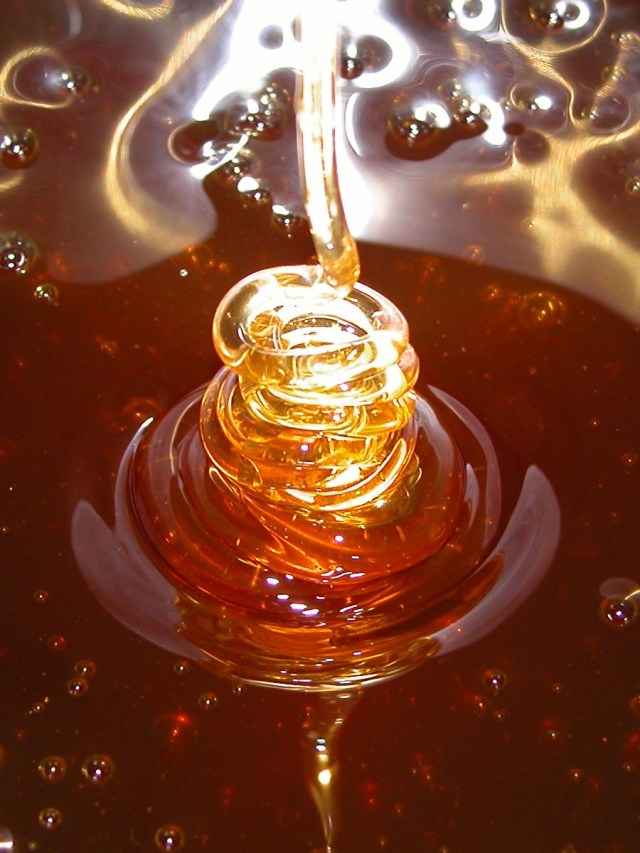
honey dripping

– a review of Parfums Micallef Le Parfum Denis Durand Couture

When most people think of haute couture these days, they think of the few designers left who are true couturiers, red carpet events, movie stars and celebrities, those made-to-measure evening gowns the rest of us can only imagine. You might wonder at the exorbitant price tags, the extravagant details, the level of skill les petites mains demonstrate in beadwork, embroidery, pleats, lace, folds and the razor precision of cut and fit.

As someone who has handled a true couture gown (a vintage Balmain from the Fifties), I’ve always marveled at the inside, which is where I think couture really distinguishes itself. For an haute couture creation is at least two gowns in one – not simply the gown the rest of the world will see but a whole hidden universe of built in improvement underneath to accentuate and emphasize and blur those human imperfections away the world never needs to know.

I can imagine that would add a lot of extra va-va to your voom, knowing that no matter what happens, you are truly stunning – inside and out and from every conceivable angle.

There’s nothing new about that fertile field of mutual inspiration between perfume and couture – indeed, it’s been a mainstay of fashion and fragrance since the days of Charles Worth.

Now, in this relativistic anything goes ready-to-wear age, we have another collaboration between perfume and haute couture, only this one comes with a twist.

Denis Durand, a couturier based in Cannes whose work was featured on several stars at the recent Cannes Film Festival, commissioned a perfume from the house of M. Micallef, and just as it would be fair to say Martine Micallef has a definite fragrant aesthetic all her own, so too Denis Durand has a distinct feminine fashion forward fingerprint, which is how Le Parfum Denis Durand Couture came to be – henceforth referred to as Parfum Couture.

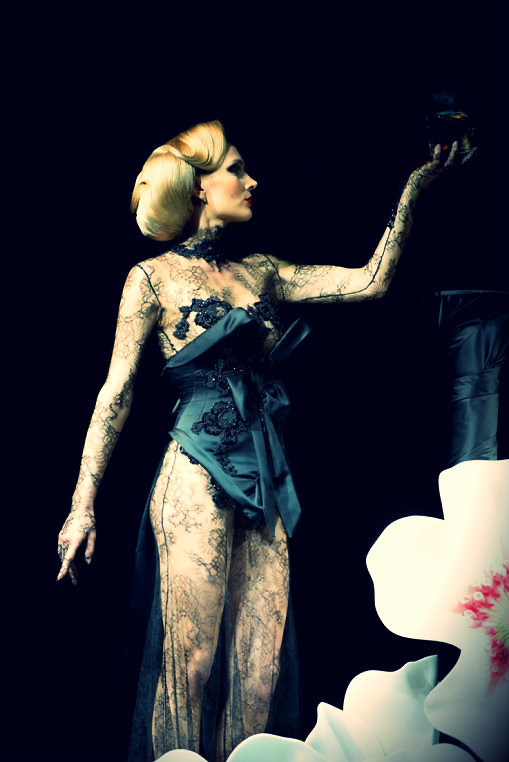
denisdurandcouture

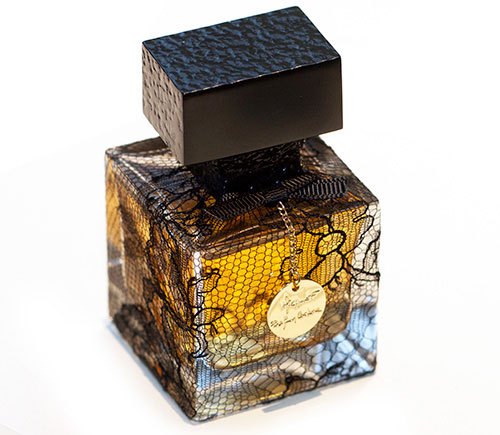
If you think the creation pictured above is stunning, take my word for it – Parfum Couture is equally breathtaking – at least, it certainly took my breath away. This is a dizzying, impossibly opulent perfume bordering on the decadent, and if Denis Durand had hoped for a reflection of his eponymous designs in a Chantilly lace-wrapped bottle, made with all the precision, layers and meticulous care of haute couture, then Martine Micallef and her in-house perfumer Jean Claude Astier accomplished that intimidating task with flying colors – and all the intricate curves and twists of that Chantilly lace.

A chic blast of cinnamon – not the usual sweet cinnamon often found in perfumes, but dry and fiery –  starts the show with its own fireworks display, teemed up with tangerine, so say the notes, but this cinnamon takes no prisoners and I get only a holographic impression of a green tangerine – like the flash of a sequin or a startling, drop dead sexy detail under the Klieg lights – before it’s gone.

Parfum Couture reveals its secrets slowly and in stages, each curving back and forth, up and down through the top, heart and base notes like an appreciative eye looking up and down la ligne and enjoying the view. The notes say Bulgarian rose, orange blossom, honey, as if to find the olfactory equivalents of lace, satin, faille and velvet and somehow breathe all of them whole into one vision – and such a one…

Into the heart, peeking just a little down this devastating décolleté, a slippery, slithery, satin flash gleams, and at this point, I’m no longer thinking of haute couture so much as the timeless feline growl of Eartha Kitt. That cinnamon made you look, but this tigerish, sensuous growl is what keeps you looking – and sniffing.

Animalis and honey, says the notes list, and there was some speculation on the fragrance boards about what Animalis is. A combination of labdanum and castoreum – which goes a long way to describe the overall effect – or else a compound made by Synarome used in many perfumes to illustrate that slightly predatory, feral purr that underpins the structure of Parfum Couture along with that liquid, golden – there is no other way to say it – honey, like a silk charmeuse glissade cascading off a pearly shoulder.

This Chantilly lace babe is every bit as wild at heart as that dress pictured above would suggest, but there’s much, much more to this slinky siren, and she hasn’t finished with the likes of you just yet.

She’s also not quite so feral as she seems, for that honey, a wild, very natural smelling, floral honey note that sings until the end – at least on me – when some long hours later – say, watching the sun rise over the Croisette – a soft, musky sandalwood remains to sing of a Night  – and a moment? – to Remember.

If you like your Orientals – and indeed, Parfum Couture is very much an Oriental – super-refined, super deluxe, super-powered and super surprising, then Parfum Couture is for you.

I can emphatically appreciate Parfum Couture’s curves and twists and catwalk turns. I do have one small problem.

Honey in perfume is one of my personal fragrant anathemas. I can eat it – as indeed I do. I can appreciate honeyed perfumes on everyone else but me. My skin amplifies honey notes to such an extent, it seems to expand them exponentially until they’re all I can smell for days afterward. Which is why I can never wear this wonder of fragrant and fashionable engineering, but I know plenty of people will, just to imagine themselves wrapped in the bespoke, breathtaking splendor…of couture, a honeyed luxe kiss they will surely make all their very own.

denis-durand-le-parfum-couture

Notes: Ceylon cinnamon, Italian tangerine, Bulgarian rose, honey, orange blossom, Animalis, sandalwood, patchouli, white musk.

Le Parfum Denis Durand Couture is available at Luckyscent, First in Fragrance and Jovoy Paris.

Disclaimer: A sample was provided for review by Parfums Micallef.

Perfectly Lovely

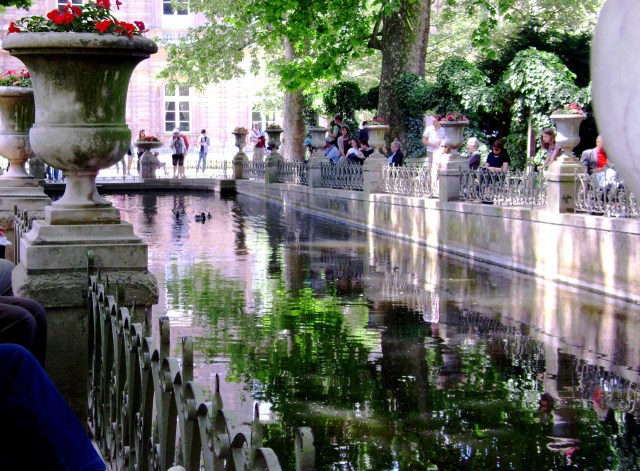
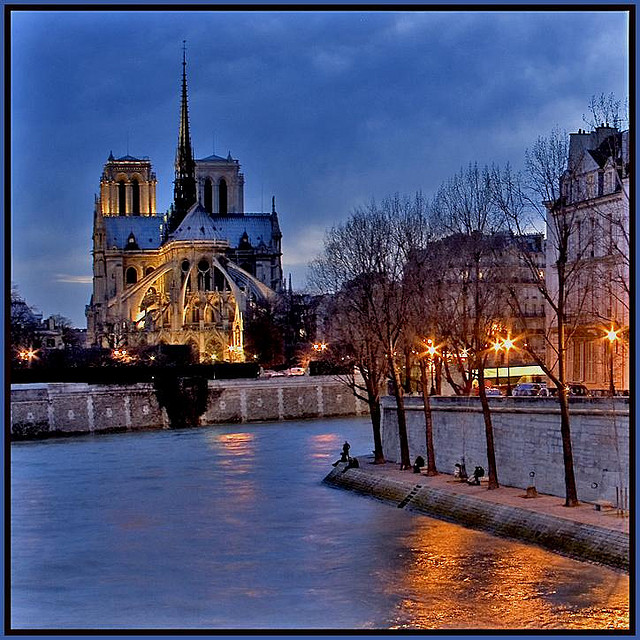
351jardin-du-luxembourg-paris-41607 – a review of Guerlain L’Heure de Nuit

Dear M. Wasser,

For all your indubitable charms, I suspect you do not have such an enviable job as we perfume writers with our twisted imaginations think. When I sniffed one of your latest creations, launched last year under a great deal of fanfare in a centennial year of very great importance, I remember I thought how difficult it must be to wrestle creatively with all the late, great and haunting ghosts of all the eminences fragrants Mssrs. Guerlain who came before you, to carry their work forward into a new era and new times and that relentless chase for new customers, new challenges, new perfumes.

Don’t get me wrong. You are yourself a rock star perfumer who counts many, many perfumes as your creations, not a few of which I own myself and am inordinately proud to waft behind me in my own quotidian and not at all glamorous life.

I’ve also got a bit of a crush, but don’t hold that against me…

So I understand something about your creative predicament. It’s a filthy job in a sordid business, but someone’s got to do it – bring the glories of Maison Guerlain into the twenty-first century, that is.

I’ve read – not having tried it, since it’s at least as scarce as real orris concrete in my part of the world – you pulled off that intimidating challenge with admirable èlan when you modernized one of the greatest Guerlains of all time, Shalimar, and called it Parfum Initial. I’ve read great things about it. I’m sure it’s good. With any luck, I might get to try it some day.

Then, Marketing socked it to you with this one. A modernization of another of the Great, the Grand, that unquestionable twentieth-century towering masterpiece that is L’Heure Bleue in time for its centenary celebration.

I felt your pain. Really, I did. That had to hurt. It must have felt a bit like recreating the Mona Lisa – in acrylic paint. On cardboard. With a palette of no more than ten colors, in this IFRA-compliant age.

Well, I can almost hear them whisper down the hall, let’s face the facts people…L’Heure Bleue is unquestionably titanic. It’s also difficult, demanding, strange, melancholy, musty, musky, and a tad…their whispers grow even more sotto voce, as if the ghost of Jacques Guerlain might appear at any moment in broad daylight in those hallowed halls at Levallois-Perret to smite them dead for emoting such heresy…démodée. But it is L’Heure Bleue.

Noblesse oblige, after all.

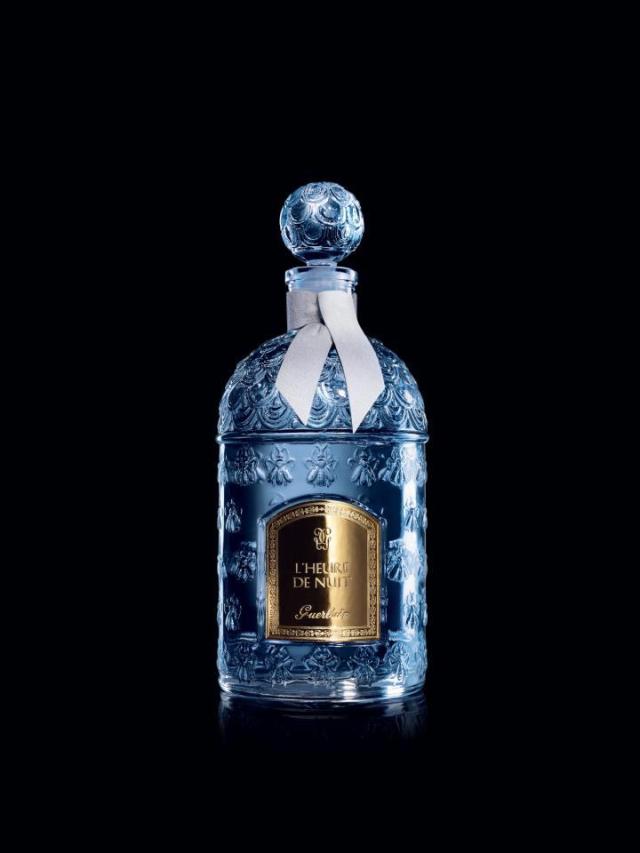
guerlain l'heure de nuit perfume exclusive

Alors. A stunningly beautiful presentation, that goes without saying. With an equally stunning price tag. Limited distribution of course, since everyone wants what is difficult to obtain. We’ll launch it in the Les Parisiennes collection, for that prerequisite je ne sais quoi touch that always heads like a Cruise missile straight for the most superheated spot on their Visas.

I wonder, though. Did you sigh heavily as you dragged out Jacques Guerlain’s original notebook and wonder why you thought this was a good idea? I wouldn’t blame you.

En avant. The juice. Did you fail at your mission, did you pull all the alchemical rabbits out of your hat, were you thrown over the intimidating fence of all that history and heritage?

Noblesse oblige. Of course you didn’t. This is why you’re Thierry Wasser and why this humble D-list perfume writer is writing about it.

L’Heure de Nuit (I’ll be getting back to that name) wears its history right on its lovely face, with a modern orange blossom twist, and what’s not to love about orange blossom? Those cherry-tinged, anisic, bitter-almond, sparkling facets of heliotrope and violet are all present and accounted for as indeed they must be in an homage, before the orange blossom boogies in on the scene with her friends iris, jasmine and a tinge of rose, but really, the heliotrope, iris and the orange blossom are the stars of the show, with all their charisma intact.

L’Heure de Nuit is nothing if not charming. Orange blossom gets me every time. And iris. I’m really big on iris. Iris adds a bit of the original’s timbre and depth to the blend with its sober restraint, and heaven knows it’s not at all easy to restrain an exuberant orange blossom once she’s in the mood for mischief and gangs up with jasmine and rose.

At the heart, I can begin to see where this is going. As a centennial tribute, you have somehow managed to pull off a coup d’état, as if to say this is a younger and far less serious age demanding a far less somber perfume. L’Heure de Nuit is far flirtier and not a little flightier, and therein lies the problem. It seems to mistake one-liners and quips for the erudite wit and intelligence of the original, and at this point, I’m feeling a bit… peeved.

M. Wasser, don’t get me wrong. It is indeed intelligent, but somewhere in my bottle, I hear a blonde – in several senses of the word – giggle. As if you had somehow managed to find a girl – my sorrow to say, L’Heure de Nuit is indeed a girl, as opposed to a woman – just smart enough to pick pointers on how to appear brainy without the tedium of actually having to bother with the real thing.

I’ll grant you this – you took that astonishing magical whiff of flour in the original and turned it into patisserie powder puff, essence absolute of dried, ground almond meringues. Less the staggering gateau Napoleon of the original – so fattening – and more one perfectly made, melt-in-your-mouth Ladurée macaron, just to say you’ve indulged…a little. A Barbie pink macaron, I should add.

At this point, I’m not so much peeved as thoroughly disappointed. If the maxim holds true that a perfume’s greatness to a large extent is determined in its drydown – which is but one of my own criteria – then here’s where you were thrown off that horse.

The original drydown of L’Heure Bleue is nothing short of haunting. Unforgettable. You simply can’t get it out of your mind. This is what men will remember the morning after, this is what they will associate with you, this is why they’ll grab the pillow you slept with when no one is looking and what they’ll bury their noses to catch, this is what will drive them to distraction for days…and nights. That drydown is why they’ll call you. Trust me. I know.

Yet this babe is gone in four hours, leaving nothing behind but a flat, rather one-dimensional impression of laundry detergent white musk – and not much else. A memory? Of course…something along the lines of ‘last night’s blonde’. Who looked an awful lot like last week’s, if blondes happen to be your thing.

L’Heure de Nuit is younger, brighter, much fresher and lighter than the original. In the same manner no woman of my age can possibly compete with the physical loveliness of youth, for one simple reason: we know too much of the world, its whims and wiles and ways.

In that sense, you succeeded – again. It’s perfectly lovely. The problem is, it doesn’t have much else than that light, that bright, that youth to recommend it. No experience, not enough depth or substance. Only a sugar daddy’s Visa so she can actually afford to buy it at that price.

Now, about that name. Please do attack whoever cooked up the name with an oversized bottle of castoreum tincture. There is nothing in the slightest ‘midnight’ or ‘nighttime’ about this heure. Like all the prettiest, youngest blondes, she blooms best in daylight.

And in daylight, she’s perfectly lovely.

Sincerely,

The Alembicated Genie.

Notes: Heliotrope, violet, orange blossom, iris, jasmine, rose, sandalwood, white musk.

With thanks to Ruth. Without whom.

Photo of L’Heure de Nuit via a favorite inspiration, The Non Blonde

Les Très Riches Heures

thebluehourParis

 – a review of Guerlain L’Heure Bleue

What constitutes a masterpiece? Is it a perfumer’s sleight of hand, some alchemical and supernatural coming together of time, space and essence that all conspires to elevate what is basically a blend of essences and oils in alcohol to that elevated plane of epiphany that simply arrests your attention where you stand, makes your blood run hot or cold and unlocks a moment, a memory or an emotion?

This was brought back to me last year when I received a sample of vintage Guerlains in a package from a friend and fellow perfumoholic that also included one of those celebrated 20th-century classics, namely Jacques Guerlain’s 1912 L’Heure Bleue. Alas, whether due to faulty packaging or airmail pressure changes, the L’Heure Bleue had leaked all through everything, and that package was, shall we say, redolent.

What surprised me the most was my own reaction. This was, after all, one of the Great 20th Century Perfume Masterpieces, as everyone did declare. Jacques Guerlain! La Belle Epoque! Art Nouveau encompasses many of my polymorphously perverse aesthetic preoccupations. L’Heure Bleue would surely be a Cupid’s arrow pointed straight at ‘love’.

So why did that saturated package smell of heartbreak and tears? Why did I catch myself thinking Kate was almost certainly wearing this in the lifeboat as she watched Leo go down with the Titanic?

Masterpiece, schmasterpiece.

I had never sniffed anything so utterly heart-wrenching in my life.

The package was thrown out.

Some months later however, my curiosity was piqued when Guerlain released L’Heure de Nuit as a tribute to L’Heure Bleue, and having a bit of a crush being a Thierry Wasser fan, I couldn’t let this one pass me by. I added myself to a split. I wanted to review it. (And so I shall!) Then again, I felt I couldn’t be fair unless I knew something of the original L’Heure Bleue, ‘so if you have a smidge of vintage to spare…’ 

You see, I also knew that that first impression had been very pop-culturally biased (James Cameron has a lot to answer for, let’s say), and exceedingly unfair.

The perfume fairy I can thank for this review obliged me by providing hugely generous samples of vintage L’Heure Bleue in extrait, parfum de toilette, eau de toilette and eau de cologne. If all those priceless treasures couldn’t convince me, nothing could.

At long last, somewhere between them all and their sparkling facets of Jacques Guerlain’s original concept, I, too felt many cerulean shades of something so intense, I could only express them by wearing a perfume…

You see, whether it was a far more open mind or else these four slightly different variations on a theme, somewhere between the extrait and the eau de cologne, the blockbuster scales fell from my eyes, and icebergs and penniless painters were thankfully the last things on my mind.

Twilight is an hour that has a special literary significance in Paris, when day and night are both poised on the brink, in countless tales it is the hour of assignations and dangerous liaisons, of heated moments with a secret lover before returning home for dinner en famille, for alors, we are French and take a practical view of these matters…

Legend has it that Jacques Guerlain set out to create a ‘blue’ accord to capture that magical hour of twilight, or as he famously stated:

I felt something so intense, I could only express it in a perfume.

As for me, I have rarely felt something so intense as the emotions captured in the liquid golden filigree of this perfume.

It does indeed strike me as blue, in fact it could not be any other color, or any other mood. Melancholy comes in many guises, yet there is a particular kind of deliciously indulgent melancholy that invites its own reveries on rainy Sunday afternoons as the raindrops chase each other down the windowpanes in Debussy dances, when you are reminded of the ephemeral beauty of all you love, when life itself catches you by surprise and somehow stops you in a moment – looking out the window, looking up at a blue twilit sky so distinctively, so emphatically defining the color blue, no painter could catch it, and no poet ever capture it.

Somehow by equal parts alchemy, skill and inspiration, a perfumer did just that. He took anise and heliotrope with all their airy, licorice and Marasca cherry edible charms, wrapped them around a decadent, earthy, floral curvilinear heart with asymmetrical, sinuous Art Nouveau twists and turns. Orange blossom and carnation and violet, audacious and bold, rose and powdery purple violet tinged with a well-bred, exquisitely mannered tuberose, all whispering all their impossible fairytales of other times and other manners when the heart of life beat at a different, more contemplative and less frenetic pace, when beauty itself was defined by the unusual and the audacious, and L’Heure Bleue, coming as it did at the end of an era and at a time when perfumery itself was being reinvented, is nothing if not bold.

For long moments between the heart and the drydown, walking this fragrant bridge between day and night, between daylight certainties and midnight possibilities, there is a big, powdery puff of flour. Yes, I did say…flour. Just a little acrid, just a little bitter, just a little shocking.

I shall surprise you, L’Heure Bleue seems to say, to all my bittersweet pleasures prove, to show there is far more, and far different, than even you expect.

And then. And then…

And then, some very long hours later for the extrait and the parfum de toilette, a little less for the eau de toilette and the eau de cologne, comes the grandest, greatest surprise of all.

That spectacular mille-feuilles and crème frangipane drydown that made Guerlain so famous. Marshmallow accord, says my research, but yours truly trained as a pastry chef at one time in my life and am the veteran of many, many batches of both puff pastry as well as crème frangipane, and what my nose tells me is not so much marshmallow – or even marshmallow fluff – but crème frangipane wrapped around mille-feuille puff pastry. It could very well be the heliotrope which does have marzipan associations for me, or it could be that ‘marshmallow accord’ combined with that hint of ‘farine du blé’, but whatever it is, it’s nothing more nor less than…magic. Both sweet and haunting, and absolutely unforgettable. It’s hard to understand today when gourmands are so ubiquitous, but this sweet-toothed pleasure must have been a revolution – or a revelation? – in its day.

I’ll crawl out on a limb and say it – for me, one of the things that defines a masterpiece is precisely its ability to stick in your mind and hold on tenacious in your imagination, to make you marvel at the privilege to live in a world where such art exists.

If the maxim that all art is ‘of its time’, an expression of the preoccupations of an age, then yes – L’Heure Bleue is inexorably of its time and age. It is the quintessence of an era when all of art was in a state of flux as liquid as the dizzy curves of a Mucha poster, when Picasso painted in shades of blue, when the Ballets Russes danced and Apollinaire breathed all his finest selves into his ink and life seemed rich beyond imagining and ripe with the promises of a limitless blue future – a future, we know in hindsight, that was altered forever by the horrors that awaited.

I wonder if this hindsight is the reason for that specter of melancholy that somehow infuses it, or if Jacques Guerlain wanted to capture the beautiful Muse of twilight as it flew before him, before everything changed, before time marched on, before the moment and the fleeting mood of time was lost… forever.

The very best part of my discovery of L’Heure Bleue has been the sublime privilege to test it in all its vintage variations. The extrait is, well, perfection in execution and wear, the heliotrope-anisic heartbeat apparent from the start to the finish line some very long time, later. The parfum de toilette is more focused on the spicy carnation and rose heart, the purple-tinged drydown has a more prominent orris note. The eau de toilette (another favorite permutation) has a dancing orange blossom and heliotrope pas-de-deux front and center, and a slightly sweeter drydown. The eau de cologne somehow manages to wrap off of these into a lighter, more summery version before it, too, waltzes off in the twilight. The longevity is outstanding, except, naturally, the eau de cologne.

Meanwhile, between the many testings of L’Heure Bleue, I began to develop a theory…

To humor my own curiosity, I presented my friend Ms. Hare with L’Heure Bleue in extrait and its centenary tribute one night, to test my theory that the highest expression of the perfumer’s art would be immediate and apparent to someone with no grasp of its heritage or history.

After all, I was biased – by my own history with the house of Guerlain, with my boundless appetite and curiosity for all things fragrant, by being a perfume writer most of all.

So I applied the modern homage and the vintage on different arms, and didn’t say which arm was which.

“One of these,” I told the bemused Ms. Hare, “is a masterpiece of the perfumer’s art, and considered one of the greatest perfumes ever created. Which one?”

She sniffed both arms. She wrinkled her brow and concentrated. She sniffed again. She laughed at the anticipation on my face. Thought for another long moment, and sniffed again. Then without a moment’s hesitation, she pointed to one arm.

“That one.”

That one, which was all the trés riches heures and all the many twilit hues of…L’Heure Bleue.

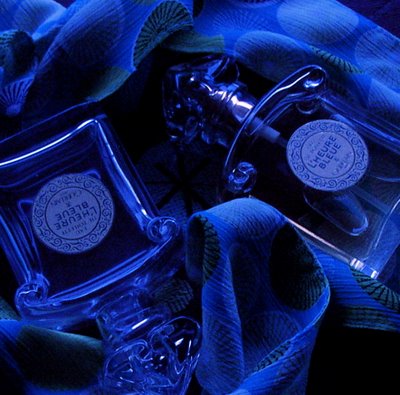
4 L'Heure Bleue (tangledupinlheurebleue)

Notes: Anise, bergamot, orange blossom, heliotrope, tuberose, carnation, violet, Bulgarian rose, tonka bean, orris, benzoin, vanilla, musk.

Thank you is not nearly large enough a word for Ruth the Perfume Fairy, who made this review possible in ways I couldn’t even imagine. I shall cherish these little bottles – always.

Also thanks to Helg of Perfume Shrine (where I found the presentation of L’Heure Bleue featured above) and Monsieur Guerlain, without both whose posts and encyclopedic knowledge this one could not have been written.