An Embarrassment of Riches

the_roses_of_heliogabalus-large

– A review of Parfums MDCI Chypre Palatin

Sometimes on gray ordinary days, those days you expect nothing more scintillating than more of the same gray, the same mundane, the same quotidian wonders of simply being alive and able to breathe, lightning will strike out of nothing and nowhere. Subterranean rumbles shake the bedrock of your soul and new, untold tales will take you unaware.

Any perfumoholic will tell you… these are the moments we breathe for, the revelations we seek, even as we all know one irrefutable fact.

You don’t find revelations so much as they find you.

This happened to me recently on a completely humdrum day, a day of few expectations and less anticipation, rooting around my perfume cabinet looking for the backlog pile, and MDCI’s Chypre Palatin fell into my hand as if planted there by the Fates themselves.

At the time I received it from a perfume fairy, I couldn’t quite decide what I thought about it. All my usual phrases came to mind – decadent, delirious, a throwback, opulent bordering on over-the-top and maybe just a bit… too much for a D-list blogger buried in the Z-list boondocks of northern Europe.

Mind you, as a devoted (if not definitively debauched) Amouage fan, that says something. To be honest, I just wasn’t sure whether I had enough chest hair for this one. My initial impressions were of shaving soap – of a kind sold in 18 karat gold cans with dead-exclusive distribution and three-figure euro price tags – but I felt this needed two glands and one appendage I certainly don’t have even on temporary loan, so back it went into the cabinet and off I moved to other preoccupations.

Yet something tugged insistent at the back of my mind about Chypre Palatin, as if it held a secret that was just beyond my reach at the time. When this happens, it also happens that a perfume I can’t quite grasp will return to haunt me later, and just as with those epiphanies, when I least expect it.

One night over the holidays while buried in a book by Edith Wharton, I dug in the cabinet for something to wear as I read. The Fates decreed it Chypre Palatin, and made the penny drop at some point in the story where I was riveted by the dastardly deeds of the British upper crust. I settled down to read, Hairy Krishna purring on my lap, and…what was that?  That minute-long burst of hyper-expensive shaving soap morphed into something so utterly beautiful, it was like hearing a three-chord death metal guitarist suddenly flip during a soundcheck and break out the first movement of Beethoven’s Pastorale and play it – exquisitely. (True story.)

All associations of shaving soap and lavender machismo were gone, and in their place was a thickly embroidered, three-dimensional tapestry of chypre, the kind of chypre you rarely find any longer, a chypre to live and breathe for.

One distinguishing characteristic of chypres, or should I say, the best ones, is their stubborn refusal to be taken apart, especially in the heart notes. Those who can are better noses and writers than yours truly, but the very best of them are so peerlessly constructed, so seamless and gravity-defying, they exist more as an evolving aura than as an easily decoded mélange of notes that progress from one stage to the next. With the best chypres, there is no linear time travel from point A to point B – they can spiral, circle and even dance around and through their notes, and all you can do is enjoy the scenery  and the story as it unfolds upon your skin.

Chypre Palatin is no exception. After that initial barbershop blast which lasts less time than it takes to tell, this marvel opens wide into a limitless horizon of plush, posh elegance with a surprising fruity-green pulse, a pulse that slowly deepens into a sweetly leathered, mossy animal throb, the kind that would spell danger were it only slightly less refined, and even then, I’m not convinced it doesn’t.

This is not your usual gender-bending masculine-leaning perfume, nothing like those run-of-the-mill ‘chypres’ that pass through the needle of the IFRA these days. This is a defiantly green and definite challenge to all of them. Chypre Palatin has a vintage heritage and a classical structure yet nothing like a vintage feel. It walks an improbable tightrope walk between opaque and translucent from its surprisingly dark opening through that blooming, fruity-floral heart all the way to its rich, brocade-leather-vanilla-moss drydown many, many hours later, and just like Beethoven’s Pastorale, with not one note, one refined phrase, one phase out of place.

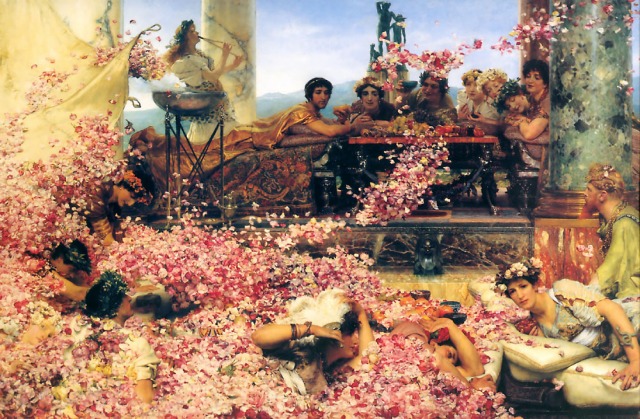
On a man of discernment, it would be devastating. On a woman, it is a sublimely elegant revelation. (At least on this woman.) As a perfume, it is, for lack of a better term, as much an embarrassment of riches as the rose petals in Lawrence Alma-Tadema’s painting above, like a moment you look up or around you – and all you can see, all you can sense is beauty everywhere you look and every time you breathe.

Notes

Top: Lavender, labdanum, hyacinth, galbanum, sage, clementine, aldehydes

Heart: Iris, jasmine, gardenia, rose, plum

Base: Styrax, benzoin, tolu balsam, vanilla, castoreum, leather, costus, oakmoss and immortelle

Chypre Palatin was made by Bertrand Duchaufour in collaboration with the Creative Director of Parfums MDCI – Claude Marchal. Parfums MDCI Chypre Palatin is available directly from the Parfums MDCI website by email request, at First in Fragrance and Luckyscent. Parfums MDCI also has an exquisite sample program of 5 12 ml samples redeemable with any full-bottle purchase.

With deep gratitude to Diane for providing this window of opportunity! For the review of Chypre Palatin I wish I could have written, I recommend Suzanne of the Perfume Journal.

Image: Sir Lawrence Alma-Tadema, The Roses of Heliogabalus (1888).

The Most Beautiful Love Stories

ysl1

– a review of DSH Perfumes’ YSL Retrospective Collection

If you ask me, the phrase ‘fashion designer’ has today lost much of the cachet it once carried. In a day and age when virtually anyone with a certain bent, a publicist and financial backing can write ‘fashion designer’ on their resumé, fashion has been diminished to fad, and all fads are as fleeting as a passing mood.

Yet once in a very different time, one fashion designer more than any other changed how we perceive fashion and style even today, even as so many modern fashion designers pillage his very heritage…one fashion designer changed the world, the clothes, and the lives of the countless millions of women who loved, worshiped and adored his work.

Yves Saint Laurent.

No other designer was quite so in tune with his times (sorry, Karl!), and no other designer has had such a definitive impact on how we even perceive those two words ‘fashion’ and ‘designer’. He was arguably the first couturier to conceive of that heretical notion ‘prêt-à-porter/ready-to-wear’ with Yves Saint Laurent Rive Gauche, the first designer to claim that style was an individual statement rather than a sartorial dictate and the first to celebrate women of every ethnicity both on the catwalk and many diverse cultures in his designs. In terms of fashion, Saint Laurent is responsible for a very long list of firsts.

Yves Saint Laurent’s work was exhibited last year in a comprehensive retrospective at the Denver Art Museum – one of only two such exhibits in the US, and as she has before with their Secrets of Egypt and Cities of Splendor exhibits, indie perfumer par excellence Dawn Spencer Hurwitz offers her own olfactory tributes to six pivotal moments in Yves Saint Laurent’s career.

I’ll venture that in terms of paying homage to perfume history, no one does it better than Dawn Spencer Hurwitz. Whether consulting ancient Egyptian papyri for the recipes for her ‘Kyphi’, ‘Samsuchinon’ or ‘Susinon’ (favorites of mine to this day) or conjuring the celebrated cities of the Italian Renaissance, she has shown not only a true dedication to the culture behind it, but also an in-depth understanding of the olfactory philosophies of the times and places she chose to evoke.

I was excited to receive these six odes to Yves Saint Laurent, both for the compliment Dawn paid me in sending them, but also for personal reasons. First, because one major personal perfume satori moment at age fourteen involved an Yves Saint Laurent perfume (and likely his clothes as well) on the Pont Neuf in Paris in the spring of 1977, and second because my mother loved his work to such an extent, she’s buried in an Yves Saint Laurent Rive Gauche dress. For the longest time, the only designer I could afford was an Yves Saint Laurent perfume or lipstick and sometimes both at once, but with that kind of armor on my person, the rest of it, as the saying goes…was immaterial!
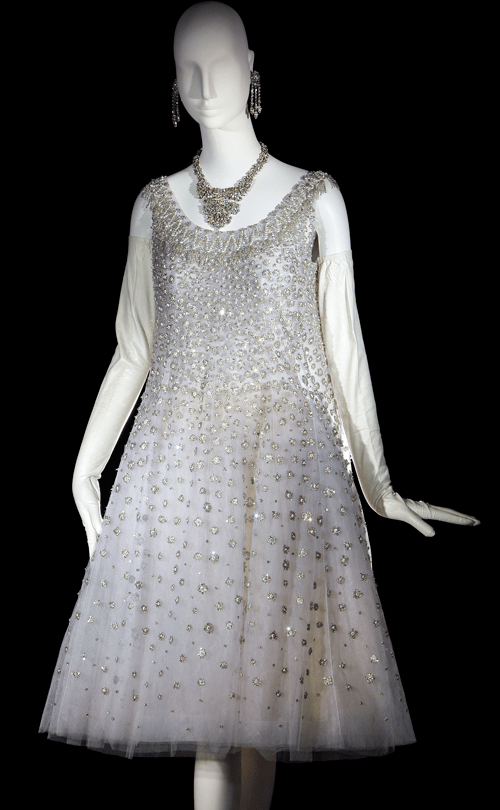
Trapeze-dress

Ligne Trapêze

When Saint Laurent succeeded Christian Dior after Dior’s sudden death in 1957, he did it with all of France watching his every move intently. The house of Dior was, as one newspaper reporter stated at the time, a matter of national importance. At the tender age of twenty-one, Saint Laurent gave Dior La Ligne Trapêze, a move away from the strictly tailored and corseted designs of his predecessor into a looser, freer, A-form and altogether younger style. Dawn’s Ligne Trapêze is likewise a loose, free adaptation of the classic perfumes of the era such as the great Diorissimo. It begins with a bright, fruity, aldehydic champagne fizz. The peach listed in the notes is quite prominent along with the lemon, but then – just as perfumes used to, just as they rightly should if you ask me – it blooms. The whole opens up wider into a seamless, airborne bouquet of floral fantasy. I can detect lily-of-the-valley, the rose and the jasmine, certainly, and even a hint of heliotrope. I could tell you the notes, but if you love the great chypres of yore, with their endlessly fascinating twists and turns and surprises, Ligne Trapêze will be no exception, not even into the deliciously decadent drydown hours later when the civet and the castoreum growl their sweetly seductive, animal purrs before they, too fade away and leave a whisper of silky suede in their wake, as surely you will, too.

Notes: Aldehydes, amber, ambrette seed, animalia, Australian sandalwood, bergamot, Brazilian vetiver, castoreum, Centifolia rose absolute, grandiflorum jasmine, heliotrope, jonquil, lemon, muguet, orris concrete, peach, rosewood, Siam benzoin, suede accord, violet.
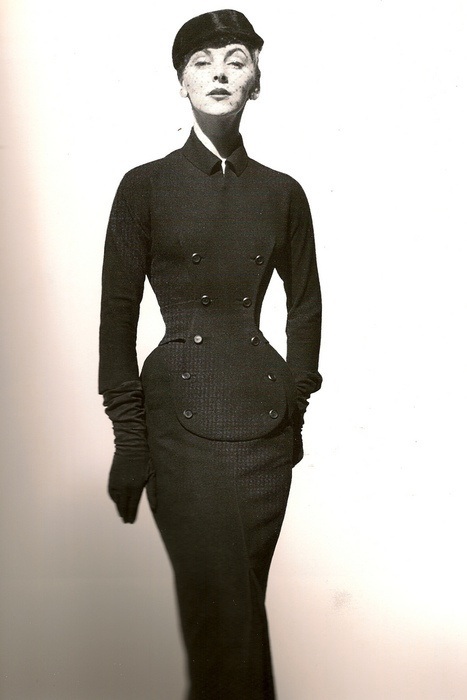
dior1958

The Beat Look

For his next collection for Dior, Saint Laurent sought his inspiration in the beatniks of the Left Bank, with their penchant for black turtlenecks and leather jackets, but fashioned by Dior in the most luxe way imaginable, in silks, cashmeres and… Crocodile leather motorcycle jacket, anyone? It must surely be a testament to the furore this collection provoked that I couldn’t locate a single image to illustrate it. (The above illustration was taken from Dior’s Winter 1958 collection) Dawn was inspired by YSL’s first eponymous perfume, ‘Y’, but whereas my memory of ‘Y’ was a rather fearsome chypre bête verte, Dawn’s is altogether softer and not nearly so demanding. Here is another aldehyde wake-up call, but in The Beat Look, the plummy, fruity top yields to more prominent florals. On me, the gardenia, hyacinth and the honeysuckle sing their cool, perfect arias quite clearly, before giving way with a grin to a superb leather base, and if that’s not a reference to that jacket (Heaven help me if I ever locate one!), I don’t know what is. I wore The Beat Look to work one day when I was sequestered for a few hours with some colleagues into what amounted to a large walk-in closet, and left The Beat Look behind me. The next day, one of my superiors came up and asked me what I’d worn, before she added plaintively, “Why don’t they make perfumes like that any more?” Luckily for us, Dawn does.

Notes: Aldehydes, amber, animalic, Australian sandalwood, bergamot, Brazilian vetiver, Bulgarian rose absolute, centifolia rose absolute, civet, East Indian patchouli, gardenia, grandiflorum jasmine, green oakmoss, honeysuckle, hyacinth, leather, mirabelle plum, musk, neroli, orris, peach.
52384_640

Le Smoking

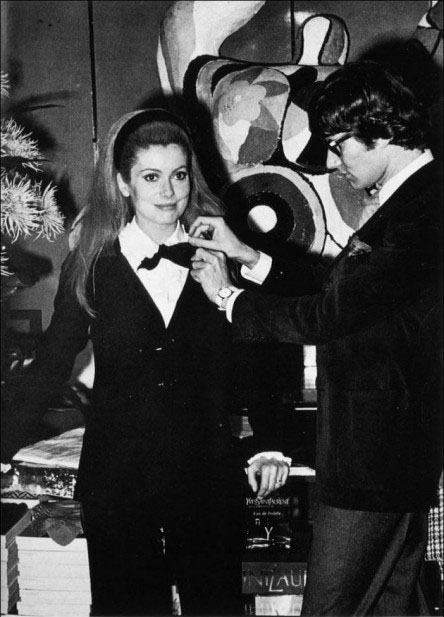
It’s hard to understand today the impact Saint Laurent’s justly famous Le Smoking had on womankind as a whole, not simply the lucky ones (Catherine Deneuve included) who could afford it. A woman highlighting her femininity in men’s clothing was nothing new – George Sand in the 19th century, Marlene Dietrich in Morocco in 1930 – but in Le Smoking – or a knockoff – and heels, any woman had the impact of a pulse bomb. The ever-stylish Lauren Bacall – a longtime Saint Laurent fan – was once refused entry to a fancy restaurant  for wearing it.  It is just as timeless, as empowering and as relevant today as in 1966. For Le Smoking, Dawn bottled up the sum entire of female subversion and an era, too. As a green chypre, it had me, no question, at ‘Hello!’ Green, bitter, and not compromising in the slightest, it is as smoky, as sensuous, as intriguing and as perfectly sexy as anything can be in black wool crepe and stiletto heels. From that initial galbanum glow until that buttery, leathery, mischievous, delicious smoke ring of Mary Jane and tobacco, this is an instant time travel and an instant and still relevant aspiration – that classics will always endure, and as surely as M. Saint Laurent knew and Dawn Spencer Hurwitz certainly does, sexy is not so much the clothes and accoutrements of femininity, but an attitude, and Le Smoking – both the outfit and the perfume alike – has both in spades and to spare!

Notes: Bergamot, blackberry, brown oakmoss, Bulgarian rose absolute, carnation, castoreum, Chinese geranium, clary sage, galbanum, grandiflorum jasmine, honey, hyacinth, incense, leather, marijuana accord, neroli, orris, Peru balsam, tobacco absolute.

opiumdress1978

Euphorisme d’Opium

In the late 1970s, overt drug references were simply just not done. The scandal of Opium – both its name, its tagline (‘For women addicted to Yves Saint Laurent’), its opulent world launch in a Chinese junk in New York harbor, even its Japanese-inspired bottle, were an instant, worldwide sensation and an instant sellout, despite being banned for import in many countries, even in the US. (They simply shipped it in non-descript packaging, repackaged it, and voilà!) If ever a perfume embodied the Studio 54 era of decadent excess and drop-dead disco glamour, surely it would be Opium? If people know nothing else of Yves Saint Laurent, they know Opium, for you had to live under a rock in the Gobi desert to avoid it in the late Seventies, or the countless imitations that followed it. (Cinnabar, anyone?) I had girlfriends who swore by it and wore it by the bucket in every permutation. My mother wore it for a time, before she moved back to her beloved Shalimar. As Oriental perfumes go, Opium was another gold standard of feisty, fierce spice-and-fire, and in Dawn’s version, it is nothing more nor one whit less spectacular than its inspiration. The carnation-clove-orange and cinnamon beginnings – a large part of what made the original so distinctive – are here dampened a bit compared to the Opium I remember, and since I recall Opium sillage trails so thick you could taste them (those were the days, people!), this is no bad thing. Instead, it’s Opium without quite so much of a perfume hangover the next day, brighter and lighter and altogether a glorious twist on a perfume so iconic, I don’t even have to locate my mini of the original. I close my eyes, and in a twinkling of that spice and that fire, in the benzoin, myrrh-laden, vanilla embers that spark and flame long, long hours later, I’m all there and still happily caught in that moment, singing “Hot Stuff” along with Donna Summer.

Notes: Aldehydes, amber, Atlas cedarwood, bay leaves, bitter orange, Bulgarian rose absolute, carnation, cinnamon bark, civet, clove bud, East Indian patchouli, Eastern lily, grandiflorum jasmine, honey, incense, mandarin, musk, myrrh gum, peach, pimento berry, pink peppercorn, Siam benzoin, spice, vanilla, ylang ylang.
lavieenrose

La Vie en Rose

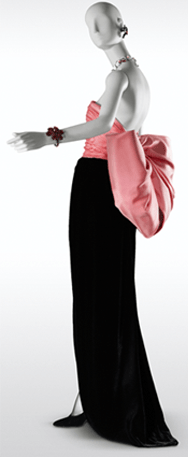
On the day Dawn’s YSL collection arrived, after devouring the letter that came with it and the press prelease, too, I wasted no time and less breath in heading like a guided missile straight for La Vie en Rose, and this time, it was very much personal. Unlike Opium, which I never wore since some of my girlfriends did, I wore YSL Paris once I headed out of punkdom in my early twenties. I wore Paris in the eau de toilette and the parfum and the bath gel and the body lotion and sometimes all at once (true story), I wore Paris to work and on sizzling dates and girls’ night out, I wore Paris any chance and every chance I got. So far as I was concerned, Paris was the epitome of everything rose and everything perfect in my less-than-stellar life, and in fact, one boyfriend even asked many years later if I still wore it. What could I say? I loved it without reservation and inhibition, as you can only do in your twenties, and heaven help me, I’d love it still if it had not become reduced to a (misguided) rumor of its former glory. When a perfume so perfectly embodies a philosophy of life it inspires even the designer to make a dress such as the ‘Paris Bow’ pictured above, that means…something. So out it came, my little bottled wonder of La Vie en Rose, on it went, and then…this grown woman of jaded mien and grown-up responsibilities and (supposedly) grown-up tastes…cried. For La Vie en Rose is very much more than my own rosy-violet-linden tinged memories of my twenties, but more than that, it’s the Paris I remember, without being quite so bombastic, yet as perfect as only the very best recollections can be. From its first breath of fruity, green-tinged linden blossom through its epic, expansive rose-and-violet heart and without any of those rose-violet associations of lipstick I so dislike, this is the answer to that perennial question…Why do I love perfume? Because of perfumes like La Vie en Rose and perfumers like Dawn Spencer Hurwitz, because the best are so emotionally evocative, so utterly transporting in time and place, I can withstand anything at all, so long as I have beauty such as this to breathe. That’s why.

Notes: Aldehydes, Australian sandalwood, bergamot, cassis bud, Centifolia rose absolute, civet, French lily, French linden blossom accord, green clover blossoms, green oakmoss, heliotrope, moss, muguet, musk, neroli, violet, violet leaf absolute, Virginia cedar, wood violet, ylang ylang.

Ma Plus Belle Histoire d’Amour

Named for an embroidered wisteria and yellow jacket and a classic French love song, Ma Plus Belle Histoire d’Amour is a floral perfume that could equally well be called Impossible April. Impossible, for how does it happen that wisteria and linden blossom waltz so well in tandem, and is the ozone (not a note I encounter very often) that keeps this bouquet so expansive and open all through, like the French doors flung open on a day of sunshine after rain, when all of nature blooms before your eyes? I dare you to tease out the blooms one by one, but I can recognize what must be wisteria underneath a brocaded, embroidered opening of bergamot and linden blossom, rose, a touch (a very light touch) of jasmine and ylang and certainly lily-of-the-valley, too, but all along this perambulation through spring, vanilla hums sweetly in the background with its friends sandalwood and musk, but so lightly, so elegantly, you don’t even notice some hours later when that door to this impossibly gorgeous April day closes, and alas, it is over. Then again, tomorrow is another day and hope springs eternal…

Notes: Australian sandalwood, bergamot, Bulgarian rose absolute, civet, Dassinia orchid, East Indian patchouli, French linden blossom accord, honeysuckle, lemon, linden blossom absolute, muguet, musk, ozone, sambac jasmine, vanilla, wisteria, ylang ylang. (All notes from DSH Perfumes)

It’s not hard to find traces (and outright theft) of the immense legacy Yves Saint Laurent left behind, in the many modern designers who steal what they find, in his extraordinary command of color and technique, or simply in that definition of style he was the first to advocate and so many of us follow even today. But these six perfumes are much more than cover versions of perfume songs we used to know, so much more than riffs over the familiar themes and tropes we now take for granted in perfumery. They are all imbued with that deft restraint Dawn adds to all her perfumes, never so overpowering as to leave you breathless in the wearing, but always, like the best of art and the superlative best in perfumery art, exhilarating, inspiring, and as flawlessly executed as any Parisian couture.

To be beautiful, a woman needs nothing more than a black pullover, a black skirt and to be in the arms of the man she loves. – Yves Saint Laurent.

To which I could add, but if you really want to knock ‘em down…wear any one of these heartstopping tributes. Because, as the Maître also once said…

My most beautiful love story…is you.

As indeed Catherine Deneuve and Laetitia Casta sang on the fortieth anniversary of YSL to a visibly moved Saint Laurent.

Sometimes, we perfumistas are very, very lucky, that the very best love stories can be bottled, too.

The YSL Retrospective Collection is available directly from DSH Perfumes, as 5 ml dram perfumes, as 10 ml. Eau de parfum sprays, and as a coffret set.

Image credits: Photos of ‘La Ligne Trapêze’ dress & ‘Paris Bow’ dress from designsponge.com, taken from the Denver Art Museum’s exhibition. Black and white photo of model in YSL couture by Jean-Loup Sieff. Photo of Dior suit, 1958 from oakcat.tumblr.com. Photo of Catherine Deneuve with Yves Saint Laurent in1966 via nastassie.livejournal.com. Photo of ‘Opium’ dress (1978) from the Costume Institute’s collection, Metropolitan Museum of Art, New York

Disclosure: Samples were sent for review by Dawn Spencer Hurwitz. Whom I owe an oversized apology for such a belated review! 🙂

S*** Happens

fumes-854312_35689530

– a review of Guerlain’s Encens Mythique d’Orient

Dear M. Wasser,

Before I incriminate myself to such an alarming degree, I’d like to start by declaring myself an empahtic fan of your work, especially your astonishing work continuing the great heritage of Guerlain. Guerlain and all its perfumed wonders have a special place in my heart – for one, the very first perfume I ever chose for myself was a Guerlain – Jicky extrait, quite an audacious choice for an ingénue fourteen-year-old.

I fell for your own inarguable talents far too many years later thanks to a friend and distinguished perfume blogger named Carrie, who knew just what buttons to push in order to get me to invest my paltry fortune in a family – gourmands – I had formerly overlooked if not derided, and also to part with an exorbitant amount of money for a perfume I had never sniffed, and that was Iris Ganache. It was a purchase I have never had cause to regret unless to bewail its discontinuation.

So understand this pains me a great deal – more than you know. In my over two years as a perfume writer of ill repute and less esteem, I have broadened my horizons and expanded my limits to a degree never imagined before I began this perilous and ruinous descent into the odiferous maelstrom that is…perfume.

You could argue that I am perhaps a philistine, that I have no appreciation or knowledge of the terrors or delights of perfume artistry. To which I counter with the many exemplars in my cabinet from a diabolical competitor based in the Palais Royal. I rest my case.

In being one of your countless admirers, it follows that my devotion is such I’m prepared to forgive you a great deal and always give your work a second, or third, or even seventh chance as the occasion merits. Therefore, any new release from the house of Guerlain is cause for great anticipation if not excitement – a new Guerlain! How will dear Thierry Wasser astonish us now?

Such was my eager train of thought when yet another and seemingly unattainable series was released to much edification on Planet Perfume, and although my acquisition of these marvels was delayed by other factors known as “real” and “life”, eventually, Fortune deemed it timely that I, too – buried nose-deep in the Perfume Empty Quarter of Europe – should have the opportunity to sniff and to wonder at these new creations by your hand.

Lo and behold – the peerless majesty invoked in the collection known as ‘Les Deserts d’Orient’, and the one that called to me louder than any lonely djinn in a water gourd – Encens Mythique d’Orient.

I’m quite aware of the challenges inherent in a trio marketed towards an audience with somewhat different fragrant sensibilities than we milquetoast, spineless strawberry blondes languishing in the dimmest, bleakest outreaches of Northern Europe’s left armpit. I’m no stranger to ouds, mukhallats or attars, nor even to those heinous, screechy jasmines which ostracize you so deftly from all polite society. But I have a definite weakness for the many wonders of frankincense, whether Omani, Somali or Indian, so when a full set of Les Deserts arrived thanks to an enterprising friend, I wasted no breath and less time to head straight for the eponymous mythical incense of the Orient.

M. Wasser – my kudos to you. It begins in such a glorious fashion, all gold-embroidered damask and a slithering, silver-smoky undercurrent of L’Animale Fatale…less frank about the frankincense unless as an ideal of what incense could be. I regret to say I am transported…not to some elevated passage of the Rubai’yat or that eloquent turn of phrase Rumi was justly celebrated for, but rather…to one of those licentious, nay – salacious descriptions that run rampant throughout Sheikh Nefzaoui’s ‘Perfumed Garden’ which so delighted Sir Richard Burton and so dismayed the Victorian mind. I am neither deterred or dismayed – my own disposition is many thousands of leagues removed from the Victorian.

Then, some time later, you do shock me. For after that glorious, gold damask opening comes…not visions of the chic of Arabie, not the romance of a limitless desert sky nor even the sensuous secrets revealed by a hakim to an all-too willing pupil…but something so utterly unnerving, my words fail to quite convey the degree or extent of my dismay.

As I stated above, I’m no stranger to shock. But to quote the amusing American idiom…

WTF???

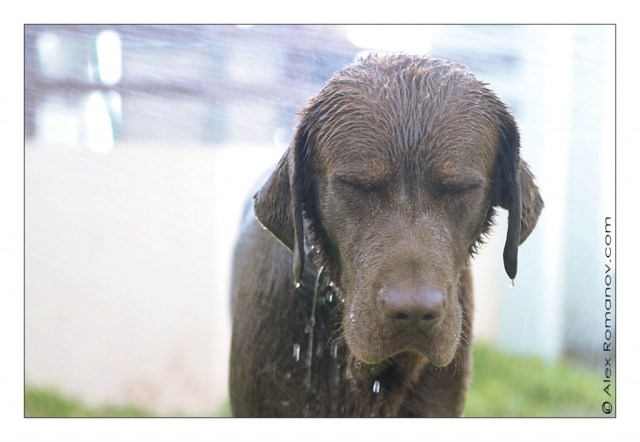
For what follows is best described by the image below:

16-Wet-dog-Alex-Romanov-1024x708

Yes. Wet dog. Not just any dog, but a hunting hound abandoned for hours in the driving, icy rain as its fellows bounded on with the horses elsewhere while it located a scent trail far more to its liking than any fox could muster.

To be fair, this sorry canine comes with an impeccable pedigree and a hundred generations of perfect temperament and training at the least. This is no mere back-alley dog. This is a Guerlain dog, and so more refined, more elegantly delineated than lesser-esteemed hounds, nevertheless, a wet dog is a wet dog, and a wet, cold and hungry dog – as surely this poor, unfortunate creature must be – is the sorriest, wettest, most miserable and thoroughly wretched creature of all.

At this juncture, I despairingly consult my notes as well as other, far more discerning noses of other, far more refined perfume bloggers, and all to no avail – the wet and wretched creature remains perched in the air above my skin with its reproachful brown eyes and its distressing, apologetic stance, and this irritates me no end.

You see, M. Wasser, I am a dedicated lover of cats – indeed, I’m owned by two – and by this time, more peeved than you can possibly imagine that this conjuration of a very luxurious perfume orchestrated by your magical hands and nose has incurred some cataclysmic shift in my perceptions, and with a creature I could appreciate quite fondly had the circumstances been rather better. Say, in real life, bounding through the meadows throwing sticks to catch, not wafting out of an opulently decorated and very hard to obtain perfume bottle, never mind perched on my wrist, dripping its melancholy, well-bred raindrops all over a priceless Ikea rug.

I refused to believe the obvious. It couldn’t be you. It had by necessity to be me, and my own pathetic limited, unsophisticated nose playing its tricks and practical jokes on my mind. So I gave it seven more tries on seven other nights that grew longer as time passed.

Now, I had eight wet dogs dripping all over the carpet. My cats…well, I’m sure you can imagine the unfortunate consequences. I had to draw the only conclusion I could. It wasn’t me. It was you.

Or else it was simply that this milquetoast wan exemplar of Scandinavian design not in flat packaging  and ‘d’un certain age’ didn’t have the pedigree, the breeding, the politesse to appreciate either the perfume – or that sorry dog in the bottle.

So I shall do my best to perservere as well as I can – through the remainder of Les Deserts d’Orient. I shall forgive you – for now. I shall even forgive you to such an extent, the friend who sent me this doomed dog has tempted me with something blue, brand-new and altogether more to my liking, and yes, M. Wasser, you made this one, too.

As for this malodorous endurance test, I shall attempt my own worst impersonation of the Gallic shrug you so excel at, and quote your own august self – again, with yet another fitting American term of opprobrium tinged with a little black humor unrelated to any the dogs might have brought in…

Shit happens.

Yours sincerely,

Tarleisio, the Alembicated Genie

Notes for Encens Mythique d’Orient: Aldehydes, neroli, moss, saffron, Persian rose, ambergris, musk and frankincense

The Les Deserts d’ Orient line is available from the Guerlain flagship store in Paris, the Place Vendôme Haute Parfumerie, Harrods and Selfridges in London, and in many locations throughout the United Arab Emirates, Saudi Arabia and Kuwait.

With thanks to that perfumed friend – and an apology to the ghost of Edith Wharton.

Image of wet dog: Alex Romanov.

Baudelairean Blooms


woodviolet – a review of Parfums Serge Lutens’ ‘Bois de Violette’

Among the many blooms adored by perfumers and perfumistas alike – the regal lilies, the imperious irises, the fatal tuberoses, sensuous jasmines, opulent orange blossoms and that Empress of them all, the rose – one tiny, unassuming spring flower stands half-concealed among this distinguished bouquet, not doing much to call attention to itself, unless it is to confer its own sweetly green air of innocence and youth, so charming yet so modest. Or else it reminds us of dear, departed grandmothers and aunts and their fondness for posies and pastilles, candied petals on chocolate cakes and tiny, mauve soaps languishing in a porcelain dish you never dared to use, stamped with ‘Savon Violette’.

There’s a vintage if not old-fashioned aura around the humble violet, something that smacks of nostalgia, bygone eras, scented with a tinge of melancholy and the ephemerality of time. Marry the violet to rose in certain proportions and you get the fragrance and flavor of lipstick, pair it with its companion violet leaf, and you have an approximation of spring-in-a-bottle, all exuberant greens and bashful blooms playing peekaboo among the greenery. Many of those violets are lovely, sugary, as sweet and as substantial as fleeting promises you just know will never be fulfilled.

All the same, something haunts me about violet, something that tugs insistent on the edges of my mind and gives me an urge to bury my face in a tiny bunch of violets in a woodland glade, something that makes me want to grasp that ethereal perfume and bite it…

Which means I’m no fan of those sweet, restrained, grandmotherly violets. I like my violets with a Gothic edge, their dulcet melody of early spring tempered with an alto counterpoint. In other words – a violet that surprises me.

Here is Serge Lutens’ Bois de Violette, and as any reader of this blog knows, any Serge Lutens perfume is nothing if not surprising.

Bois de Violette and I did not get along the first few times we said hello. A glorious violet, so said the reviews I read, so I felt more than a little cheated when I smelled the ashen cedar tones of pencil shavings, and nary one violet beneath my nose.

It was a red flag in front of this Bull! When all I wanted to do, just as in the story of Ferdinand the Bull, was to sit in a sunlit spring field and smell the flowers.

Some time ago, a perfumista friend asked me if there were anything I would like to try from her extensive collection, and when Bois de Violette came up in the conversation, I jumped at the chance to finally grasp these elusive blooms and banish the pencil shavings to the cedar box they surely belonged in.

Many have stated that Bois de Violette is the sister scent of Feminité du Bois, and it isn’t hard to see the family resemblance in their structure, or indeed to recognize the jazzy riffs of improvisation over a familiar theme of cedar – and surprises. For all her heritage, Bois de Violette is not another Feminité du Bois and has none of her sister’s plummy, Bourgogne-tinted depths.

Instead, she sings in a different, higher register, and begins her own violet revolution by conjuring forth a fairy forest in emerald tones of green, and somewhere in the background, an intimation of shadows with that pine-cedar accord that never remains too far away. This may be a forest, and fairies may dwell here, it seems to say, but secrets and ghosts lie somewhere just beyond. Heed them well.

Except you won’t, for next thing you know, the fairies arrive, which is to say, the very violets that give Bois de Violette its name, and those memories of old-fashioned, old-school, grandmotherly violets are banished forevermore to that cedar box of mementos they surely belong in.

These violets have other, wilder stories to tell, stories with sweetly worded phrases of twilit purple dreams and candied hexameter breaths of leather and anise that grow darker as the shadows deepen and the violets sing their siren songs of dark green cedar, and you listen enchanted as they fade, and the cedar steps forward again to remind you – the hour is getting very late, and not all that grows in this forest is what it seems, and not all that breathes is as entirely benign as those fairies that sang away the hours on your skin.

In this enchanted forest of Faërie lurks a Big, Bold, Cedar Wolf, and it just might bite if you’re not careful…

Bois de Violette won’t overwhelm your surroundings as you wear it. It stays close to you, but never strays.

Instead, this is what you would choose to wear for your own pensive pleasure, whenever the mood for a little needed introspection with just a touch of joy grabs you, when the melancholy grays of endless rainy afternoons are almost more than you can bear, and you want a peerless, perfumed reminder that some day, spring shall return again, and light and life as well, hidden in a woodland glade to catch you unaware.

As for me, with my predilection for the Gothic in les violettes, I find that Bois de Violette is a liquid bloom that Baudelaire would surely appreciate, if indeed he wasn’t referring to them when he wrote:

Charme profond, magique, dont nous grise

Dans le présent le passé restauré!

Ainsi l’aimant sur un corps adore

Du souvenir cueille la fleur exquise.

Or in a freer translation I couldn’t improve if I tried:

It’s by such charms that Nevermore

Intoxicates us in the Now –

As lovers to remembrance bow

Over the bodies they adore.

Parfums Serge Lutens ‘Bois de Violette’ is available at Luckyscent and directly from the Parfums Serge Lutens website.

Quote from Charles Baudelaire’s ‘Un Fantôme’ (1861), translated by Roy Campbell 1953, courtesy of Fleurs Du Mal.

With thanks to two perfume angels who made such Baudelairean blooms – and words! – possible.

A Myth Beyond Time

sphinx2

– a review of Esscentual Alchemy’s reinterpretation of Guerlain’s Djedi

Among perfumistas, certain things are a given. You will always want more  – or different – than you have at any given time, and if you possibly can, get your perfumed paws on that elusive unicorn creature…the very rare, the super-exclusive, the myth. Some perfumes are precisely so rare, so mythical, so elevated into the stratosphere of near-unattainable that to simply own a sample is to elevate you by extension.

Few are more rare than Jacques Guerlain’s Djedi, if you can even find it at all. Created by Jacques Guerlain in 1926 at the very height of the Egyptian craze that followed in the 1920s after Howard Carter’s discovery of Tutankhamon’s tomb in 1922, it is named for a fabled magician in a story of Khufu first mentioned in the Westcar Papyrus. And all the reviews I’ve ever read have mentioned just how haunting, how strange, how utterly removed from  the usual Guerlain vanilla patisserie sensibilities Djedi is, it might as well have been made by someone else entirely.

I’ve never tried Djedi that I can recall, so I’m not able to say. As serendipity would have it, it so happens I have the next best and far more obtainable thing…and that is Amanda Feeley of Esscentual Alchemy’s recreation/reinvention of this famous, strange oddity, and if Amanda’s version is anything at all like the original, all diehard perfumistas and lovers of vintage perfumes should take note, sit up and pay attention…

This is no mere ‘perfume’, no simple spin on a famous fragrance. Amanda Feeley has shown herself an eminently talented perfumer and participated in many group perfume projects including my own Devilscent Project. Lately, Amanda gave herself the creative challenge of recreating – or reinventing – some of those most beloved classics of yore, the ones we can no longer find, the ones we diehards dream about obtaining if only we could find them. When she told me about her work with Djedi, I couldn’t sit still, haunted by the specter of what I had read and thought about the original. Excited was not the word. Chypre! Animalic! Strange! Odd! I bounced around the living room, much to my former roommate’s delight, although she never did understand precisely what it was about this myth that had me bouncing off the walls…

Djedi! It was almost too good to be true…

So now I have it and wear it. Sacred Isis, this is stunning stuff.

It opens with a bitter, eerie, ghostly rose, if roses somehow had the ability to rise at a midnight hour from some underground crypt to haunt you. Haunt you it certainly does, growing ever more bitter-green by the moment as what must be vetiver (I didn’t get a list of notes) and oakmoss kick off their dust and emerge from their dry linen wrappings in all their timeless glory far more eloquently than Boris Karloff ever managed.

Bitter, yes, green, oh yes, dry as timeless desert sands, but so seamless, so elegantly restrained, as a luxurious, dark leather note emerges, I battle both my preconceptions and my meager attempts to find the words to express what I smell and no less what I feel, for as surely as I live and breathe, they really don’t make these marvels any longer. One layer, one moment at a time, Amanda’s Djedi breathes its mystery, patchouli (a definite vintage-feel patchouli), musk and civet adding their own feral growls to its power, giving the whole an edge, a force (yes, I said that!) of its own that skirts just this side of intimidation – precisely what I love most of all about chypres – that underlying breath of steel to fortify my spine. The drydown arrives after over an hour to remind me of other, later, famous chypres with their own razor edges and feline purrs, that fabulous leather/patchouli accord persisting for hours to follow on my skin.

I read in the reviews of Guerlain’s Djedi I could find that it was a perfume of sorrow and bitter mourning. Jacques Guerlain had somehow managed to add more than a little heartbreak into his creation. This version of Djedi has that characteristic in common with it, this is not something you would want to wear for a carefree, casual, happy-go-lucky day.  This is a perfume of perservering in the face of all adversity, of donning your armor and claiming your true power, of cloaking yourself in a myth beyond time to soldier on through your own challenges, no matter how small – or large. Djedi the magician of the original story had the power to bring the dead back to life, severed heads or no, and this Djedi too has that undercurrent of secret power behind it, to bring you back from whatever brinks you might have found yourself upon,to stand protected and secure when the time comes to roar those demons in the face.

Amanda Feeley’s Djedi will probably make most mainstream perfume consumers run for the hills. If you dislike leather, if you hate animalic perfumes, head straight for the nearest Nile crocodile and do not pass Go. It does have that emphatic vintage feel missing from most perfumes today, which is not to say it isn’t every bit as relevant or as wondrous as anything in the superlative best of indie perfumery today.

On the other hand, if you’re anything like me and many, many perfumeoholics I know, start a petition to have this made as soon as you can. Guerlain’s Djedi may be lost forevermore, thanks to IFRA restrictions, a tendency to play to the lowest common denominators and commercial interests, but thank all the Gods of time and timeless Egypt, we have Esscentual Alchemy and Amanda Feeley to restore our hopes that artistry really does exist, and even unobtainable, mythical perfumes can be resurrected or reinvented from beyond time, and when they are and you can wear them, you too shall rise like a Phoenix to burn again, burning through all those myths of life itself and even of your life, too – all those myths beyond time.

I didn’t receive a list of notes for Esscentual Alchemy’s ‘Djedi’, but Helg of Perfume Shrine gives the notes of Guerlain’s Djedi as: Rose, vetiver, musk, oakmoss, leather, civet and patchouli.

For reviews of the fabled Guerlian Djedi, I highly recommend Perfume Shrine’s, Dimitri’s of Sorcery of Scent, and Yesterday’s Perfume.

Esscentual Alchemy’s all-natural perfumes can be found here. Read the original story of Khufu & The Magician here.

Disclosure: A sample was made for review by Amanda Feeley of Esscentual Alchemy. For which I thank her from the bottom of my chypre/leather/oakmoss/vintage loving heart.